9 Signs Your Well Pump Is Going Bad: Catch Pump Problems Early Before You Lose Water Completely
A well pump almost never dies without warning. If you know the signs your well pump is going bad, you can usually fix a small problem weeks or months before the taps run dry. This guide shows you what to watch for, what each sign means, and what to do about it.
I have spent more than a decade pulling failed pumps out of wells. In most of those jobs the owner had noticed something odd long before the water stopped.
Quick answer
The most common signs your well pump is going bad are falling water pressure, a pump that clicks on and off quickly, sputtering faucets, sand or cloudy water, a rising electric bill, a pump that never shuts off, and a breaker that keeps tripping. One sign alone is a reason to investigate. Two or more together mean you should act this week.
This article may contain affiliate links, and we may earn a commission from purchases made through those links. For more information, please refer to our disclosure.
Why Catching Pump Problems Early Matters
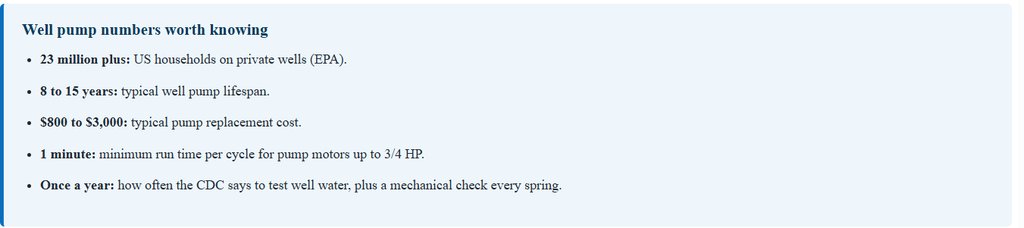
The EPA estimates that more than 23 million US households rely on private wells, which is over 43 million people. No utility monitors those systems. If your pump quits on a Saturday night, you are the one who has to solve it.
Most well pumps last between 8 and 15 years, and replacement typically costs $800 to $3,000 depending on depth and pump type. A new pressure switch or a tank air recharge often costs less than a tank of gas.
The pump is rarely the first thing to fail. A tired pressure tank, a worn switch, or a dropping water level usually damages it slowly, and each one gives off signals you can spot.
9 Signs Your Well Pump Is Going Bad
1. Water pressure that drops or swings
Weak showers and faucets that fade are the earliest warning for most homes. Worn impellers move less water, so the pump struggles to reach its shut off pressure. A leak in the drop pipe causes the same symptom.
Watch the pressure gauge near your tank while someone runs a tap. It should fall steadily to the cut in point, then climb back smoothly. A needle that crawls upward or stalls below the cut out setting means the pump is losing strength.
If pressure only dips when several fixtures run at once, see our guide to the best constant pressure well pump systems.
2. The pump clicks on and off quickly
This is called short cycling, and it kills more pumps than age does. Every start sends a surge of current through the motor and creates heat. The motor needs running time to shed that heat.
Motor guidelines call for a minimum run of one minute for 4 inch motors up to 3/4 HP and two minutes for larger ones. A healthy home system may only cycle about 10 times a day.

Example figures from R.C. Worst & Co. A pump cycling 300 times a day may not survive two years.
The usual cause is a waterlogged pressure tank that has lost its air charge. See our well pressure tank guide for sizing and pre charge steps.
3. Faucets that spit and sputter
Air bursts from the tap mean the pump is pulling air along with water. The water level in the well may have dropped close to the pump intake. A cracked drop pipe or a failed tank bladder can also let air in.
A submersible pump relies on the water around it for cooling, so running dry can destroy it quickly.
4. Sand, grit, or cloudy water
Sand in your toilet tank or faucet screens points to a problem down the hole. The pump may be set too close to the bottom, or the well screen may be failing. Either way, sand grinds impellers like sandpaper.
A look inside the casing settles the question quickly. Our review of the best well inspection cameras shows what a homeowner can see without pulling the pump.
5. An electric bill that keeps climbing
A worn pump runs longer to deliver the same water. A 1 HP pump draws roughly 1.5 kilowatts, so two extra hours of run time a day adds about 90 kilowatt hours a month. At an example rate of 17 cents per kilowatt hour, that is about $15 a month for nothing.
6. A pump that never shuts off
If you hear the pressure switch click on and never click off, the pump cannot reach its cut out pressure. Common causes are a worn pump, a large leak, a stuck check valve, or a well that can no longer keep up. Shut the pump off at the breaker if it runs for more than 20 to 30 minutes with no water in use.
Continuous running is hard on the motor and can pump a slow well dry. Protect a slow well with one of the well pump protection devices we recommend.
7. A breaker that keeps tripping
A breaker that trips once after a storm is not a crisis but that trips again and again means the motor is drawing too much current or the wiring is shorting to ground.
Never keep resetting it. Call a licensed pump contractor or electrician instead.
8. New noises from the tank or pipes
Rapid clicking at the pressure switch, a banging sound when the pump stops, or a loud hum from a jet pump are all new information. Clicking points to short cycling. Banging usually means a failing check valve.
Grinding or screeching from an above ground jet pump means worn bearings. If yours is at that stage, our guide to the best shallow well jet pumps will help you choose a replacement.
9. A change in taste, smell, or color
Rusty or smelly water is not always a pump problem, but it can be. A corroding pump or drop pipe sheds iron, and a falling water level pulls in sediment from the bottom of the well.
The CDC advises testing your well water whenever taste, color, or smell changes. A USGS study of 2,100 private wells found about one in five had a contaminant above a human health benchmark. If the test shows iron, start with our iron filter guide.
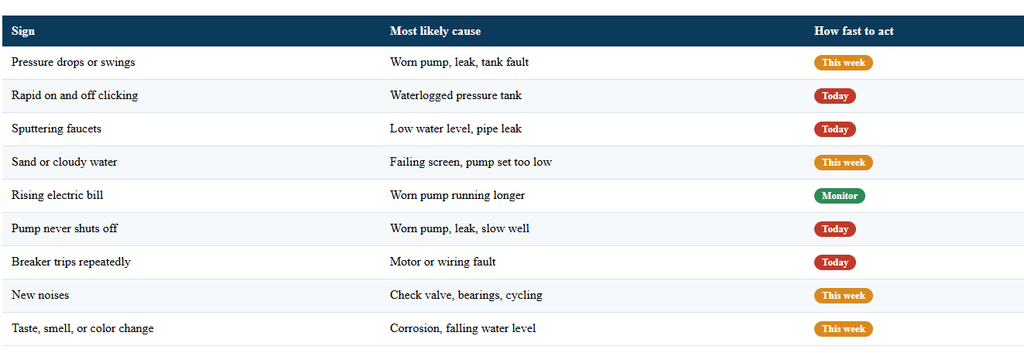
Warning Signs at a Glance
The 5 Minute Monthly Pump Check
You do not need to be a driller to catch pump problems early. You need five minutes, a watch, and a notebook.
- Read the gauge. Open a faucet and note the pressure where the pump starts and where it stops. On a common 40/60 switch, those numbers should be close to 40 and 60 PSI every time.
- Time the cycle. With one faucet running, time how long the pump runs. Anything under one minute is short cycling and needs attention.
- Check the tank air charge. Twice a year, turn off the pump, drain the tank, and test the air valve with a tire gauge. It should read 2 PSI below your cut in pressure.
- Listen and look. Stand by the tank through one full cycle. Note any new clicks, bangs, leaks, or rust stains.
- Log the water level. Measure the depth to water a few times a year. A falling level explains many pump problems before they turn serious.
That last step is the one most owners skip. Our guide to the best water level meters and well sounders explains how to take the reading safely.
A simple pump check kit
- Low pressure tire gauge for checking the tank air charge.
- AC clamp meter for comparing pump amp draw with the motor nameplate.
- Replacement 0 to 100 PSI pressure gauge if yours is stuck or fogged.
Boreholeflow earns a commission on qualifying purchases at no extra cost to you. Read our disclosure.
A Field Story: The $40 Fix That Became a $2,400 Bill
A family of five called us after their water stopped on a Sunday morning. Their well was 240 feet deep with a 1 HP submersible pump that was only six years old.
The father told me the pressure switch had been clicking a lot since the previous summer, and the kitchen faucet had started to pulse. They had assumed it was normal for a well.
The pressure tank told the whole story. Its bladder had failed and the tank was full of water with no air cushion. The pump had been starting every time someone washed their hands, and I timed the cycle at about 12 seconds.
That motor had made hundreds of starts a day for almost a year. The windings were burned and the pump had to be pulled and replaced, along with the tank. The total came to about $2,400.
A tire gauge on the tank valve the summer before would have caught it. The family now checks the gauge on the first of every month.
What You Can Fix Yourself and When to Call a Pro
Some early fixes are well within reach of a careful homeowner. Recharging tank air, replacing a pressure gauge, and cleaning a clogged pressure switch nipple are simple jobs. Always switch off the breaker first, because most pump circuits run at 230 volts.
Call a professional for anything inside the well or the control box. Pulling a submersible pump from 200 feet takes proper lifting gear, and a dropped pump can ruin the well.
The National Ground Water Association recommends an annual well check by a licensed or certified professional. One visit a year is cheap insurance on a system that supplies every drop your home uses.
If the pump truly is at the end of its life, plan the replacement instead of waiting for the failure. Our guide to the best submersible well pumps for deep wells matches horsepower to depth and flow so you buy the right size once.
Have a Backup Before You Need One
Even a well maintained pump will fail one day. A small backup plan turns that day from an emergency into an inconvenience.
- Stored water. A cistern or storage tank gives you days of supply while repairs are arranged.
- A hand pump. A manual well pump works with no power and no motor at all.
- A generator. If the problem is the grid and not the pump, the right generator for a well pump keeps water flowing.
Frequently Asked Questions
How do I know if my well pump or my pressure tank is the problem?
Time the pump cycle and check the tank air charge first. If the pump runs for only a few seconds and the tank reads no air pressure, the tank is the problem. If the tank is healthy but pressure builds slowly or never reaches cut out, suspect the pump.
How long does a well pump last?
Most well pumps last 8 to 15 years. Pumps on clean water with a correctly sized tank often last longer. Sand, short cycling, and low voltage all shorten that life.
Can a well pump fail suddenly with no warning?
It can, usually after a lightning strike or power surge. Most failures are gradual though, and they show up first as pressure changes, short cycling, or higher power use. That is why a monthly check is worth the time.
The Bottom Line
The signs your well pump is going bad are almost always there before the water stops. Five minutes a month with a gauge and a notebook is enough to catch them.
Start today by timing one pump cycle and writing down the result. For more diagnostics, browse our full well pump troubleshooting guides.
Also Read On:
>>>Best Cistern and Water Storage Tanks for Well Systems (2026 Buyer’s Guide)
>>>Best Water Level Meters and Well Sounders: A Driller’s Picks for Home Wells
>>>The Best Well Inspection Cameras for Diagnosing a Failing Well (2026)