Best Generator for Well Pump Backup During a Power Outage (2026)
When the grid goes down, a home on a private well loses more than lights. The pump stops, the pressure tank empties, and after a few flushes the taps run dry. Choosing the best generator for well pump backup is what keeps water moving until power returns.
I have spent more than a decade sizing pumps and troubleshooting failed water systems. The most common outage mistake I see is a generator that looks big enough on the box but cannot start the pump. This guide shows you how to size correctly, then gives you four picks that do the job.
We independently evaluate everything we recommend. This article contains affiliate links, and we may earn a commission at no extra cost to you. Read our disclosure for details.
Quick answer: Most homes with a 1/2 HP to 1 HP submersible pump need a 120/240V generator with at least 5,000 running watts. That covers the pump surge plus a refrigerator and a few lights.
Top pick: the Westinghouse WGen9500DF, which starts pumps up to 2 HP and runs on gasoline or propane.
Why Well Owners Need Backup Power More Than Ever
Outages are getting longer.Energy Information Administration reports that customers averaged 11 hours without electricity in 2024, nearly double the average of the previous decade. Hurricanes Beryl, Helene, and Milton caused 80% of those lost hours.
Some regions fared far worse. South Carolina customers averaged almost 53 hours in the dark that year. If you live in hurricane, ice storm, or wildfire country, a multi day outage is a matter of when.
For well owners the stakes are higher. The EPA estimates that more than 23 million households rely on private wells, and every one of them depends on an electric pump. The agency also puts average home water use at 82 gallons per person per day.
What Happens to Your Well When the Power Goes Out
Your pump only runs when the pressure switch calls for it. Between cycles, the house lives on the water stored in the pressure tank. Once the power cuts, that stored water is all you have.
It is less than most people expect. A typical 20 gallon tank holds only about 5 to 6 gallons of usable drawdown. A standard toilet uses 1.6 gallons per flush, so three flushes and a hand wash can empty it.
A larger tank buys you more time and protects the pump from short cycling on generator power. See my guide to the best well pressure tanks for sizing math. No tank replaces backup power in a long outage, though.
How to Size the Best Generator for Well Pump Duty
Sizing comes down to three checks: starting watts, voltage, and motor type. Get all three right and almost any quality generator will serve you for years. Miss one and the pump will hum, stall, or trip the breaker.
1. Size for starting watts, not running watts
Electric motors need a burst of power to get up to speed. A 1 HP submersible pump runs on roughly 1,500 watts, yet it needs a generator of about 4,000 watts to start. That gap is where undersized generators fail.
Franklin Electric, the largest maker of submersible motors, publishes minimum generator sizes in its AIM manual. The chart below shows those minimums for standard three wire motors on a conventional generator.
Minimum generator size by pump horsepower (three wire motors)
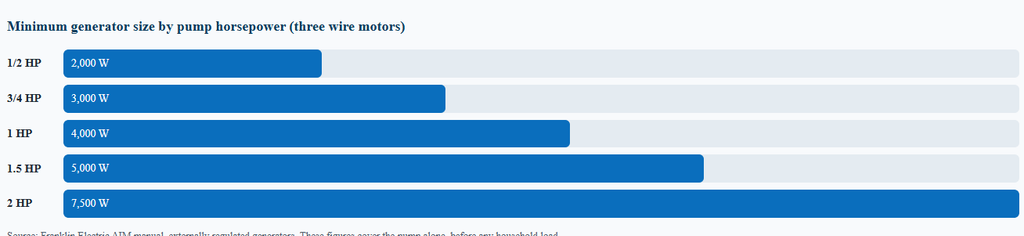
Source: Franklin Electric AIM manual, externally regulated generators. These figures cover the pump alone, before any household load.
2. Confirm you have 240V output
This is the trap that catches the most buyers. The vast majority of submersible well pumps in the U.S. run on 240 volts. Many popular small inverter generators only produce 120 volts, so they cannot run the pump no matter how many watts they offer.
Look for a generator labeled 120/240V with an L14-30R or 14-50R outlet. Then check your pump breaker in the main panel. A double pole breaker means a 240V pump.
3. Know if your motor is two wire or three wire
Three wire pumps have a control box on the wall near the pressure tank. Two wire pumps have no box because the starting parts sit inside the motor. Franklin advises adding 50% to the minimum generator size for two wire motors.
| Pump size | Three wire minimum | Two wire minimum | My pick with household loads |
|---|---|---|---|
| 1/2 HP | 2,000 W | 3,000 W | 5,000 W class |
| 3/4 HP | 3,000 W | 4,500 W | 5,000 to 6,500 W |
| 1 HP | 4,000 W | 6,000 W | 6,500 to 8,000 W |
| 1.5 HP | 5,000 W | 7,500 W | 8,000 to 9,500 W |
| 2 HP | 7,500 W | 11,250 W | 9,500 W and up |
4. Add your other essentials
You will want more than water. A refrigerator, a furnace blower, and some lights typically add 1,000 to 1,500 running watts. That is why I recommend buying one size above the pump minimum.
Not sure what pump you have? Check the control box label, your well completion report, or my overview of electric water pump types.
The 4 Best Generators for Running a Well Pump
Every pick below delivers true 120/240V output and is transfer switch ready. I ranked them on starting power, fuel flexibility, runtime, and value. Prices change often, so treat the ranges as a guide.
| Generator | Running / peak watts | Fuel | Best for | Typical price |
|---|---|---|---|---|
| Westinghouse WGen9500DF | 9,500 / 12,500 | Gas or propane | Best overall, pumps to 2 HP | $900 to $1,250 |
| Westinghouse WGen5300DFc | 5,300 / 6,600 | Gas or propane | Best budget, pumps to 1 HP | $600 to $750 |
| DuroMax XP13000EH | 10,500 / 13,000 | Gas or propane | Deep wells and big homes | $1,000 to $1,300 |
| Honda EU7000iS | 5,500 / 7,000 | Gasoline | Quiet, clean inverter power | $4,000 and up |
Best overall
1. Westinghouse WGen9500DF
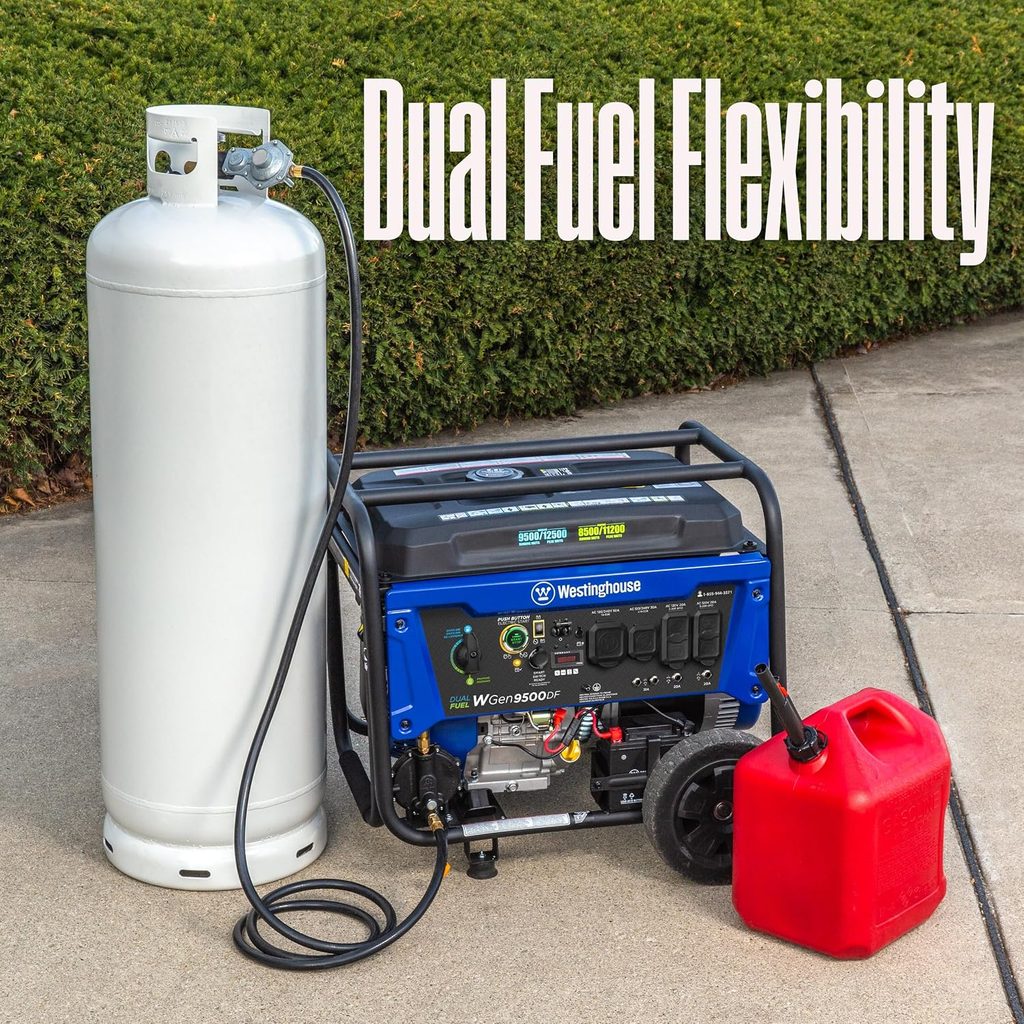
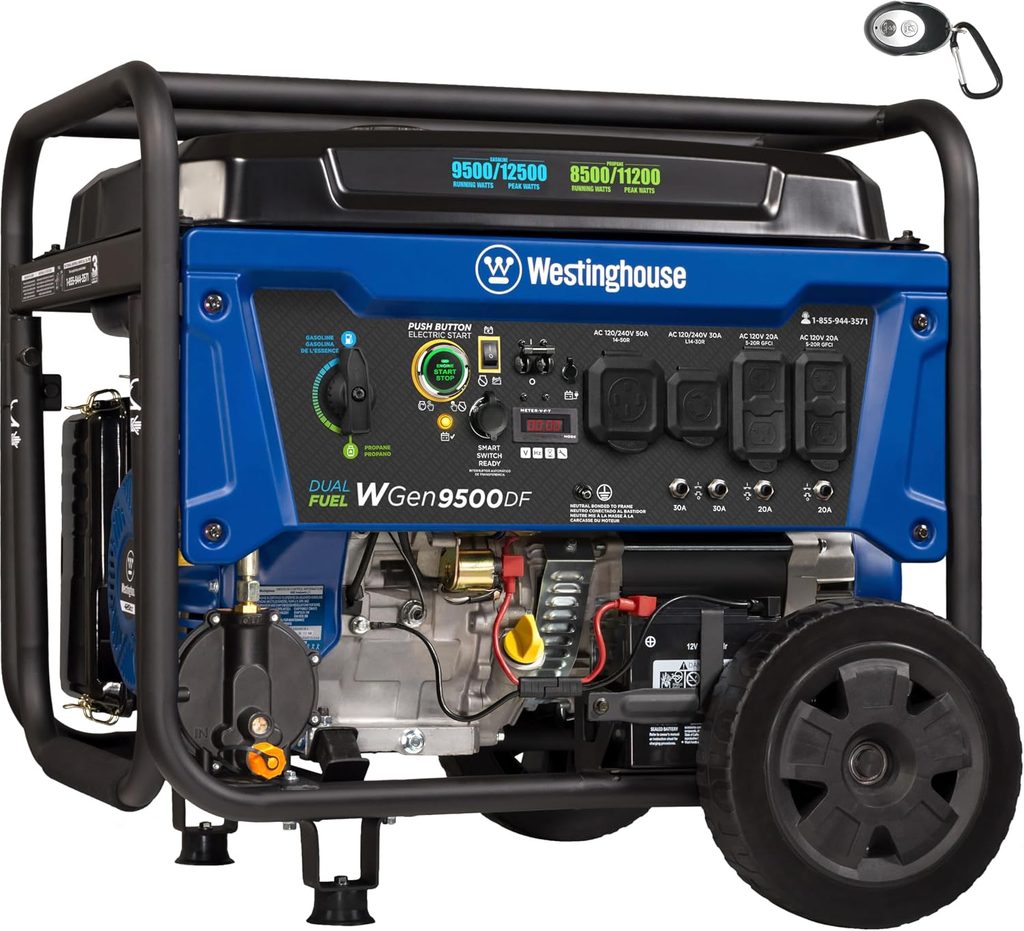
This is the generator I point most well owners toward. It delivers 9,500 running watts and 12,500 peak watts on gasoline, or 8,500 and 11,200 on propane. That is enough to start a 2 HP three wire pump with power left for the kitchen.
The 6.6 gallon tank runs up to 12 hours at a quarter load. You also get remote start, an L14-30R outlet, and a 14-50R outlet for a transfer switch. Noise is rated at 74 dBA, so place it well away from bedrooms.
Watch out for: harmonic distortion is listed at up to 23%. That is fine for standard pump motors, but not ideal for variable speed pump drives.
Best budget
2. Westinghouse WGen5300DFc
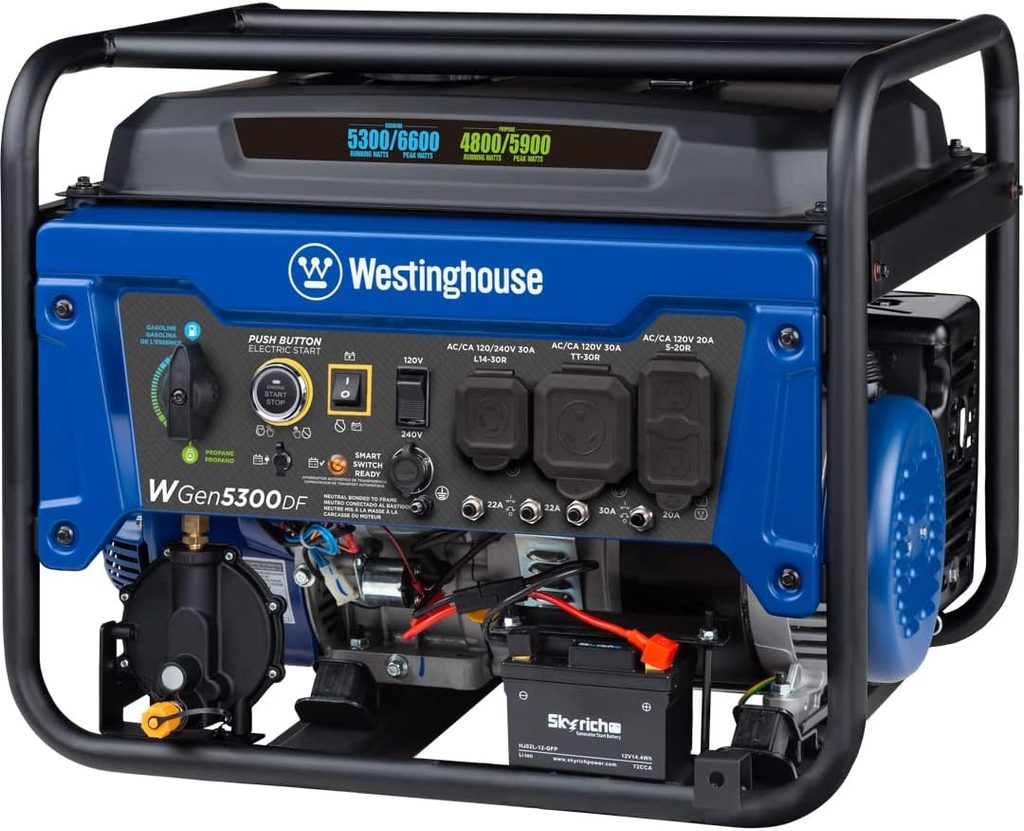
If your pump is 1 HP or smaller with a control box, this is the value choice. It makes 5,300 running watts and 6,600 peak watts on gasoline. A selector switch sends full power to the 240V L14-30R outlet, which is exactly what a well pump needs.
Runtime is up to 14.5 hours on a 4.7 gallon tank at a quarter load. It also includes a carbon monoxide shutdown sensor and a three year warranty.
Watch out for: a 1 HP two wire motor needs about 6,000 watts, so step up to the WGen9500DF for that setup.
Best for deep wells
3. DuroMax XP13000EH
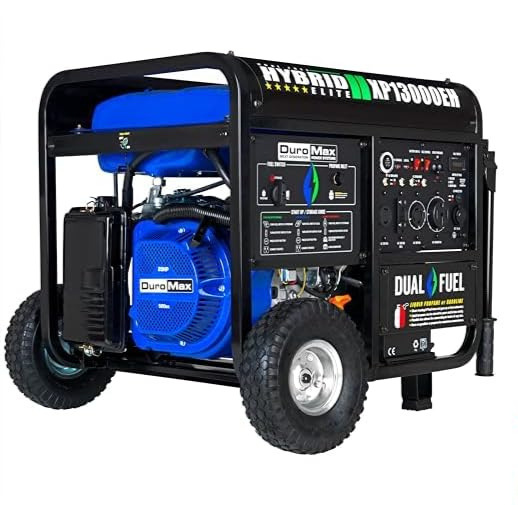
Deep wells with 1.5 HP or 2 HP pumps demand serious surge capacity. The XP13000EH supplies 10,500 running watts and 13,000 peak watts with electric start and dual fuel operation. It can carry the pump, a refrigerator, a freezer, and a window air conditioner together.
It is heavy and loud, and it drinks more fuel than smaller units. For a large rural home, that is a fair trade for never worrying about pump startup.
Best premium inverter
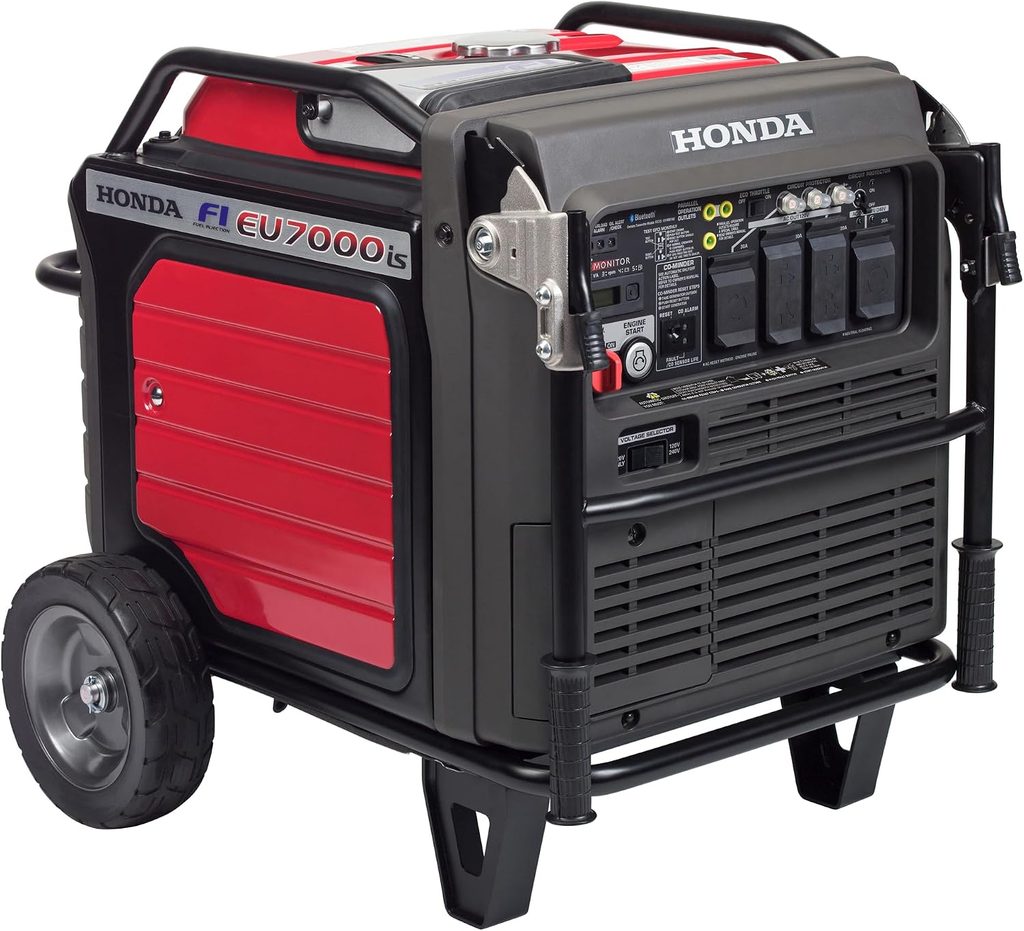
4. Honda EU7000iS
The EU7000iS is one of the few inverter generators with 120/240V output. It produces 5,500 running watts and 7,000 peak watts at just 52 to 58 decibels. Power quality is clean enough for electronics and constant pressure pump controllers.
Fuel injection and up to 18 hours of runtime at a quarter load make it the easiest unit here to live with. The catch is cost, at roughly four times the price of the WGen9500DF. Buy it if quiet operation and long service life matter most.
A Field Story: The Generator That Could Not Start the Pump
After an ice storm, a homeowner I will call Dan phoned in a panic. His family had been without water for two days, even though he owned a nearly new 4,500 watt inverter generator. The lights and refrigerator ran fine, but the pump would not start.
His well was 220 feet deep with a 3/4 HP two wire pump on a 240V circuit. The generator only produced 120 volts. No amount of wattage could fix that mismatch.
We swapped in a 120/240V unit rated at 6,500 running watts and connected it through an interlock on his panel. The pump started on the first cycle, and the family had showers within the hour. Dan had sized for watts and forgotten volts, which is the mistake I see most often.
How to Connect a Generator to Your Well Pump Safely
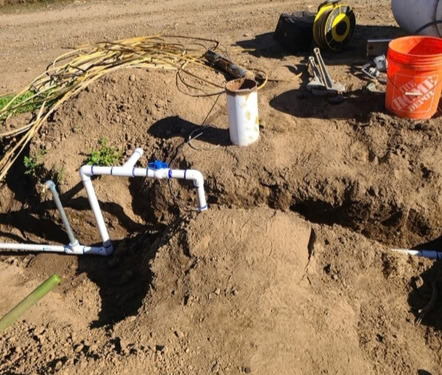
A submersible pump is hard wired, so you cannot simply plug it into an extension cord. The safe method is a manual transfer switch or a panel interlock kit installed by a licensed electrician. Either one lets you feed the pump circuit from the generator inlet.
Never backfeed your panel through a dryer outlet. It can electrocute utility workers and destroy your equipment when grid power returns. It is also illegal in most jurisdictions.
Carbon monoxide is the other serious risk. The Consumer Product Safety Commission links portable generators to close to 100 CO poisoning deaths each year. Run yours outdoors, at least 20 feet from the house, with the exhaust pointed away from doors and windows.
One more point from the field. An undersized generator does not just fail to start the pump. It feeds the motor low voltage, which overheats the windings and shortens pump life.
Fuel Planning: How Long Can You Run?
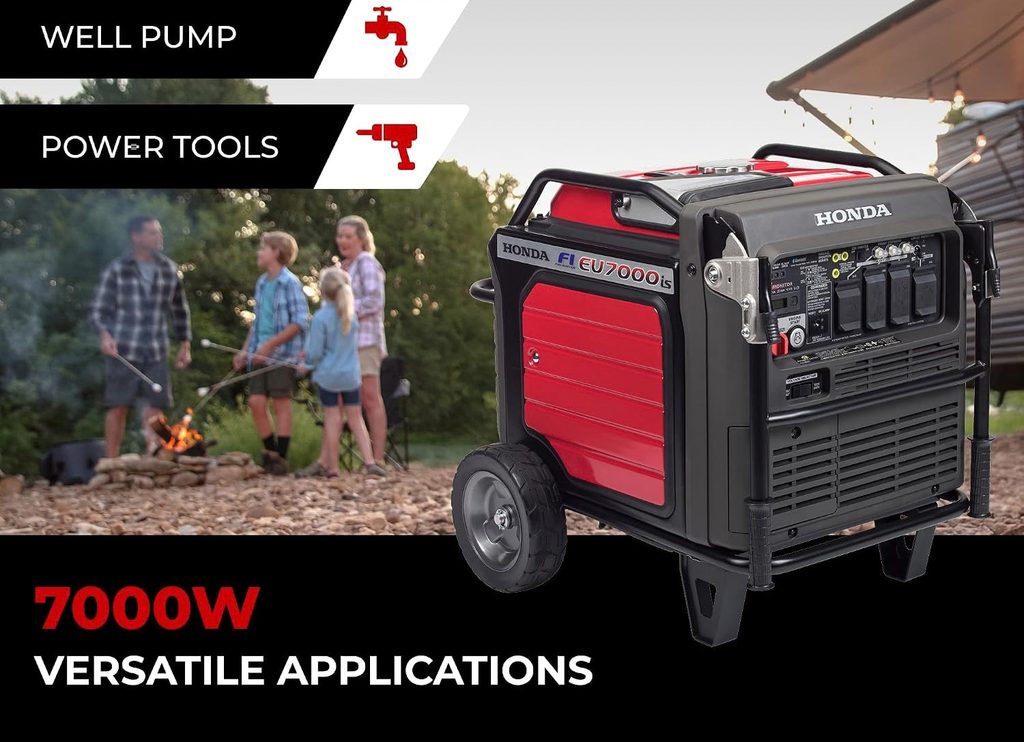
Here is the good news. A well pump only runs for a few minutes at a time, so you do not need the generator on all day. Many of my customers run it for an hour in the morning and an hour in the evening.
During each session, refill the pressure tank, fill buckets and bathtubs, run the dishwasher, and take showers. This approach can stretch a single tank of fuel across several days.
Dual fuel models earn their keep here. Gasoline goes stale within months and is scarce after a storm, while propane stores for years. Keep two or three 20 pound cylinders on hand and you are covered for most outages.
Is Solar a Better Long Term Backup?
If outages are frequent where you live, a solar pump system removes fuel from the equation entirely. It costs more up front, but there is nothing to refill. Use my solar pump sizing calculator to see what your well would need.
Many homeowners combine both. Solar handles daily pumping, and a generator stands by for long cloudy stretches. If low pressure is your everyday complaint, a water pressure booster pump may also help.
Frequently Asked Questions
What size generator do I need to run a well pump?
Most 1/2 HP to 1 HP submersible pumps need a 120/240V generator of 3,000 to 6,000 watts for the pump alone. Add household loads and a 5,000 to 8,000 watt unit is the practical choice. Pumps of 1.5 HP to 2 HP need 8,000 watts or more.
Will a 5,000 watt generator run a well pump?
Yes, if it has 240V output. A 5,000 watt generator will start three wire pumps up to 1 HP and two wire pumps up to 3/4 HP. A 120V only model will not run a 240V pump at any wattage.
Can an inverter generator run a well pump?
Only if it supplies 240 volts and enough surge power. Most small inverter generators are 120V only. The Honda EU7000iS is a proven 120/240V inverter option.
Can a generator damage my well pump?
A correctly sized generator will not harm the pump. An undersized one causes low voltage, which overheats the motor during startup. Always size for starting watts and keep other heavy loads off while the pump starts.
How long can I run my well pump on a generator?
As long as you have fuel. The pump cycles on and off, so most homes only need one or two hours of generator time per day for water. Running in short sessions saves fuel.
Final Verdict
The best generator for well pump backup is the one that matches your motor. Confirm 240V output, size for starting watts, and add 50% if you have a two wire pump. Do that and your taps will keep running through the next storm.
For most homes, the Westinghouse WGen9500DF is the safest all round choice. Smaller pumps on a budget are well served by the WGen5300DFc. Browse more driller tested guides on the Boreholeflow homepage.
Also Read On:
>>>https://boreholeflow.com/best-well-inspection-cameras/