Best Submersible Well Pumps for Deep Wells: 1/2 HP vs 1 HP vs 1.5 HP by Depth and GPM
The best submersible well pumps for deep wells are not the ones with the biggest motor. They are the ones matched to your water level and your household flow. Get that match right and a pump can serve you for a decade or more.
The stakes are real. The EPA reports that over 43 million Americans, about 15 percent of the population, rely on private wells. That is more than 23 million households with nobody but the owner responsible for the pump.
I have spent more than a decade drilling boreholes and setting pumps. In this guide I compare 1/2 HP, 1 HP and 1.5 HP pumps by depth and GPM, then share the models I would shortlist in each size.
This article may contain affiliate links, and we may earn a commission from purchases made through those links. For more information, please refer to our disclosure.
43M+Americans on private wells (EPA)
82 galused per person per day at home (EPA)
8 to 15 yrstypical well pump life
$900 to $2,500average replacement cost
Quick answer
- 1/2 HP: water level within about 60 feet of the surface, 1 to 2 bathrooms, 7 to 10 GPM.
- 1 HP: water level from about 60 to 190 feet, 2 to 3 bathrooms, 10 to 12 GPM.
- 1.5 HP: water level from about 190 to 320 feet, or big homes and long pipe runs.
These ranges assume a 10 GPM class pump on a 40/60 pressure switch. Always confirm against the pump curve before you buy.
Best Submersible Well Pumps at a Glance
| Pump | HP | Flow | Head | Best for |
|---|---|---|---|---|
| Red Lion RL12G05-2W2V | 1/2 | 12 GPM | 212 ft shutoff | Small homes, high water level |
| Grundfos 10SQ05-160 | 1/2 | 10 GPM | 160 ft rated | Premium pick, narrow casings |
| Red Lion RL12G10-3W2V | 1 | 12 GPM | 434 ft shutoff | Most deep wells, best all rounder |
| Hallmark MA0414X-7A | 1 | Up to 33 GPM | 207 ft max | High flow, moderate depth |
| Grundfos 10SQ15-330 | 1.5 | 10 GPM | 330 ft rated | Very deep water levels |
| VEVOR 1.5 HP | 1.5 | Up to 37 GPM | 276 ft max | Budget high flow and irrigation |
Why Deep Wells Need a Submersible Pump
A surface pump pulls water up by suction, and suction runs out at roughly 25 feet. Below that depth you need a pump that sits in the water and pushes. That is exactly what a submersible does.
If your water sits close to the surface, a jet pump can still be the cheaper choice. Our guides to the best shallow well jet pumps and the best convertible jet pumps cover those wells. For everything deeper, read on.
How to Size a Deep Well Pump in Three Numbers
Horsepower is the last thing to choose. First collect three numbers, and the right motor size will follow from them.
1. Pumping water level
Well depth does not decide pump size. What matters is how far the water sits below the surface while the pump is running. A 400 foot well with water at 80 feet is an easy job for a small pump.
Your driller’s well log should list the static level and the drawdown. If you have no log, you can measure it yourself with one of the best water level meters and well sounders.
2. Flow in gallons per minute
A common rule is 1 GPM for every water fixture in the home. A three bedroom, two bath house usually lands near 10 GPM. EPA WaterSense puts average home use at 82 gallons per person per day, so a family of four needs around 330 gallons daily.
One hard limit applies. Never choose a pump that delivers more than your well can recover. A 20 GPM pump on a 5 GPM well will pump the well dry and cook the motor.
3. Pressure and friction
Every 1 psi of pressure equals 2.31 feet of lift. A 40/60 pressure switch averages 50 psi, which adds about 115 feet. Add roughly 10 feet more for pipe friction in a typical home.
Add the three together and you get total dynamic head, or TDH. This is the number you take to the pump curve.
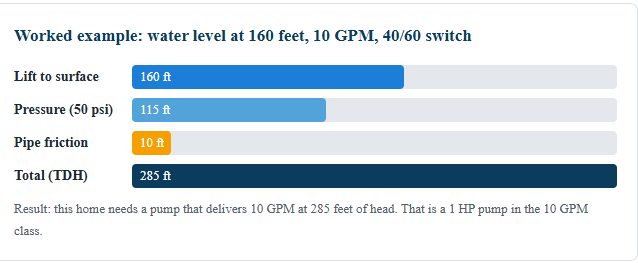
Result: this home needs a pump that delivers 10 GPM at 285 feet of head. That is a 1 HP pump in the 10 GPM class.
1/2 HP vs 1 HP vs 1.5 HP by Depth and GPM
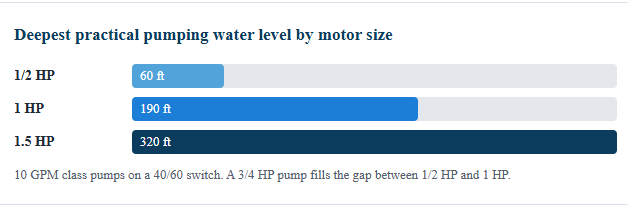
The table below shows where each size fits. It assumes a 10 GPM class pump and a 40/60 pressure switch.
| Motor | Typical head at 10 GPM | Pumping water level | Home size | Power |
|---|---|---|---|---|
| 1/2 HP | 150 to 180 ft | Up to about 60 ft | 1 to 2 baths | 115V or 230V |
| 1 HP | 280 to 320 ft | About 60 to 190 ft | 2 to 3 baths | 230V preferred |
| 1.5 HP | 330 to 450 ft | About 190 to 320 ft | 3 to 4 baths, long runs | 230V |
Why horsepower alone can mislead you
A submersible is a stack of impellers called stages. More stages give more lift, and wider stages give more flow. The motor only supplies the power.
That is why two 1 HP pumps can behave so differently. The Hallmark 1 HP moves up to 33 GPM but tops out at 207 feet of head. The Red Lion 1 HP moves 12 GPM but keeps pushing to a 434 foot shutoff.
So read the label in this order: GPM class first, head second, horsepower last. A high flow 1 HP pump in a deep well will give you a trickle.
The Best Submersible Well Pumps by Horsepower
These are the best submersible well pumps I would shortlist in each size. Product links go to Amazon, and prices change often, so check the current listing.
Best 1/2 HP: Red Lion RL12G05-2W2V
Specs: 1/2 HP, 12 GPM, 230V, 2 wire, 4 inch, 212 ft shutoff
This is the simple choice for a small home with a high water table. The 2 wire design needs no control box, so wiring is quick. Stainless steel housing and a built in check valve round out a tidy package.
Use it where water sits within about 60 feet of the surface. Go deeper than that and pressure at the tap will fade.

Premium 1/2 HP: Grundfos 10SQ05-160
Specs: 1/2 HP, 10 GPM at 160 ft, 115V or 240V versions, 3 inch
The Grundfos SQ costs several times more than budget pumps, and it earns the premium. It has soft start, built in dry run protection and overload protection. Its 3 inch body also fits narrow or damaged casings that a 4 inch pump cannot enter.
Choose it if you plan to stay in the home for many years. Pulling a pump is costly, so reliability pays for itself.

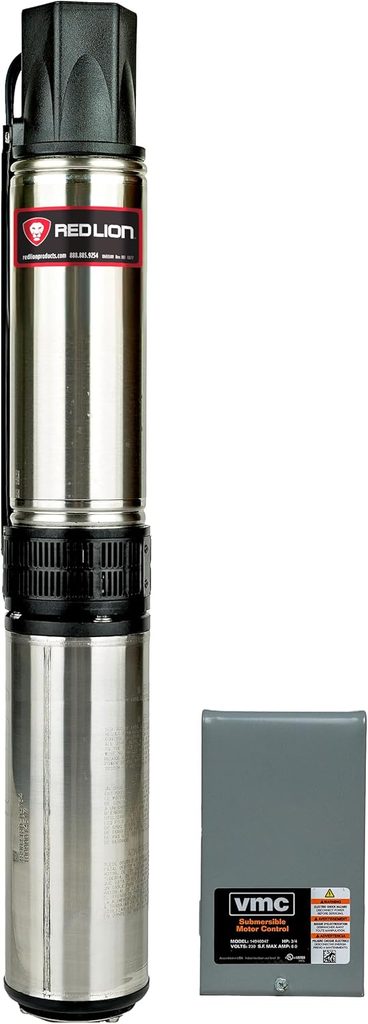
Best 1 HP overall: Red Lion RL12G10-3W2V
Specs: 1 HP, 12 GPM, 230V, 3 wire with control box, 4 inch, 434 ft shutoff
For most deep wells this is the pump I would start with. It has enough stages to lift water from around 200 feet and still hold household pressure. The control box sits above ground, so the start components are easy to replace.
It suits a two or three bath home on a well that yields 10 GPM or more.
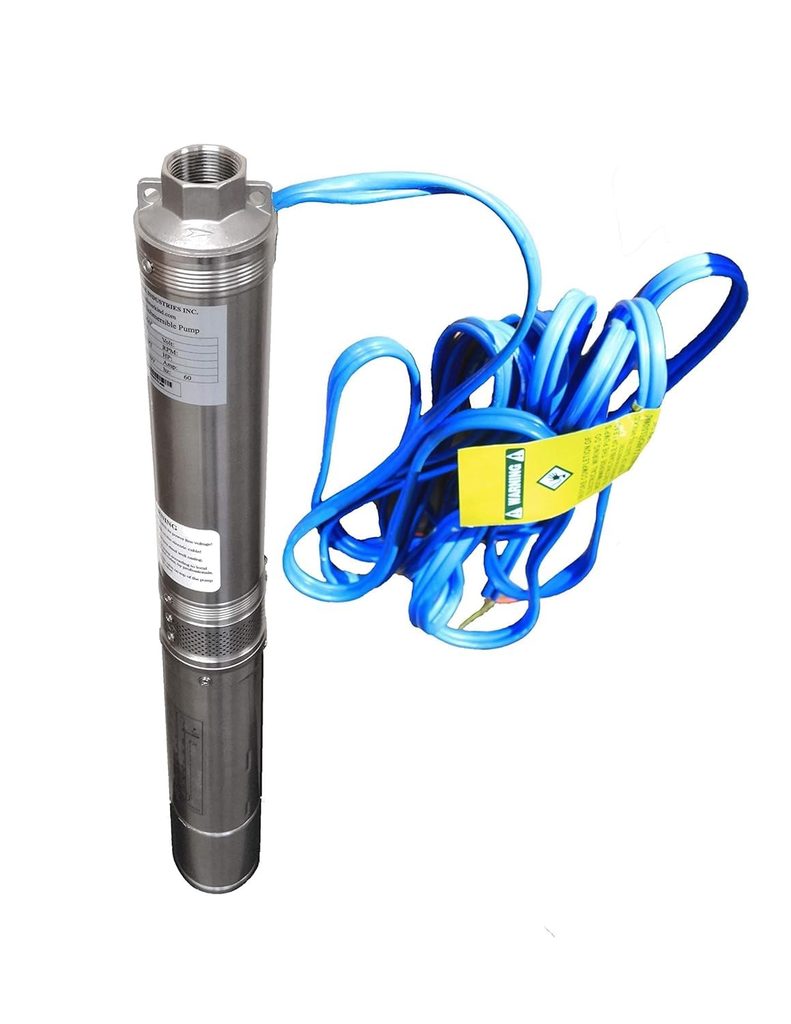
Best 1 HP for high flow: Hallmark Industries MA0414X-7A
Specs: 1 HP, up to 33 GPM, 230V, 4 inch, 207 ft max head
This is one of the best selling budget pumps in America, and the reason is flow. It suits irrigation, livestock and large homes where the water level stays above about 60 feet. All stainless construction is a bonus at this price.
Be honest about two limits. It is not a true deep lift pump, and owner reports on lifespan are mixed. Pair it with a protection device and it is strong value.
Best 1.5 HP: Grundfos 10SQ15-330
Specs: 1.5 HP, 10 GPM at 330 ft, 200 to 240V, 2 wire, 3 inch
When the water level drops past 200 feet, this is the pump I trust. It delivers a steady 10 GPM at 330 feet of head. Soft start reduces the electrical kick and the twisting force on the drop pipe.
The price is high, often well over $1,000. In a deep well, though, a cheap pump that fails early costs far more to pull and replace.
Budget 1.5 HP: VEVOR 1.5 HP Deep Well Pump
Specs: 1.5 HP, up to 37 GPM, 115V, 4 inch, 276 ft max head
The VEVOR gives a lot of flow for little money. It fits farms, gardens and large homes with a strong well and a water level above about 100 feet. It runs on 115V, which helps where 230V is not available.
A 1.5 HP motor on 115V draws heavy current. Plan a dedicated circuit and heavy gauge wire.
A Field Lesson: Bigger Is Not Better
Here is a pattern I meet again and again. A homeowner with a 260 foot well had replaced two pumps in six years. Each time the installer went bigger, ending with a 1.5 HP high flow unit.
The well log told the real story. Water stood at 70 feet, but the well recovered at only 4 GPM. The big pump emptied the casing in minutes, ran dry, then restarted again and again.
The fix was smaller, not bigger. A 1/2 HP pump in the 5 GPM class, a dry run protector and a larger pressure tank solved it. The lesson is to size for the well first and the house second.
What Else to Check Before You Buy
2 wire or 3 wire
A 2 wire pump has its start parts inside the motor, which makes it simple to install. A 3 wire pump uses a control box on the wall. I prefer 3 wire at 1 HP and above because a failed capacitor can be swapped without pulling the pump.
Voltage and wire size
Choose 230V whenever you can. It halves the current, which allows thinner wire on long runs down the well. Always follow the wire chart in the pump manual.
Casing size and condition
Most pumps here need a 4 inch or larger casing. For an older well, inspect before you install. A quick look with one of the best well inspection cameras can reveal a dented casing or heavy scale.
Protection and pressure tank
Short cycling is the top killer of pump motors. Franklin Electric, the largest maker of submersible motors, advises no more than 300 starts a day for motors up to 3/4 HP and 100 a day for 1 HP and larger. Each run should also last at least one minute.
A correctly sized tank makes that possible, so see our guide to the best well pressure tanks. Then add one of these well pump protection devices to guard against dry running and voltage faults.
Upgrades and backup power
If you want city style pressure, look at the best constant pressure well pump systems. For outages, match your pump to the best generator for a well pump.
Off grid owners have another route. Read our guide to solar submersible water pumps, or run your numbers through the solar pump sizing calculator.
What Does Replacement Cost?
The pump is only part of the bill. This Old House puts average replacement at $900 to $2,500, depending on pump type and well depth. Deep wells sit at the top of that range because of the labor to pull pipe.
Lifespan matters just as much. American Home Shield reports an average well pump life of 14 years. Correct sizing is the cheapest way to reach that number.
Whatever you install, keep the water safe too. The National Ground Water Association recommends testing a private well every year.
Frequently Asked Questions
How deep can a 1/2 HP submersible pump go?
A 10 GPM class 1/2 HP pump suits a pumping water level of about 60 feet on a 40/60 switch. A 5 GPM class 1/2 HP pump has more stages and can lift from well beyond 150 feet. Flow class matters as much as horsepower.
Is a 1 HP well pump enough for a 300 foot well?
Often yes. If the water level sits above about 190 feet while pumping, a 10 GPM class 1 HP pump will cope. If the water level itself is near 300 feet, step up to 1.5 HP.
Can a well pump be too big?
Yes. An oversized pump short cycles, wastes power and can pump a weak well dry. All three shorten motor life.
What size pump do I need below 350 feet?
Water levels deeper than about 320 feet usually call for 2 HP or more. At that depth, have a licensed well contractor size the pump from your well log.
How long do submersible well pumps last?
Most last 8 to 15 years. Clean water, a correctly sized tank and good protection push a pump toward the top of that range.
The Bottom Line
The best submersible well pumps are chosen by numbers, not by motor size. Start with your pumping water level, your GPM and your pressure, and the horsepower follows.
For a high water table and a small home, pick the Red Lion 1/2 HP, most deep wells, the Red Lion 1 HP is the best all rounder. very deep water or a home you will keep for decades, the Grundfos 10SQ15-330 is worth the money.
If you are unsure, measure before you buy. Ten minutes with a water level meter can save you a pump.
Also Read On:
>>>Best Constant Pressure Well Pump Systems: Variable Speed vs Conventional
>>>Best Hand Pumps for Wells: Emergency and Off Grid Backup Picks From a Driller
>>>Flotec FP217-810 Universal Pressure Tank Air Volume Control Kit