Best Shallow Well Jet Pumps for Wells Under 25 Feet: A Driller’s Picks
Our editorial team independently selects all products featured in this review. This article may contain affiliate links, and we may earn a commission from purchases made through those links. For more information, please refer to our affiliate disclosure.
If the water in your well sits within 25 feet of the surface, you don’t need a submersible pump, a crane truck, or a pump crew. A good shallow well jet pump bolts down beside the well, pulls water up by suction, and can supply a whole house for well under the cost of a deep well setup. The catch is that suction has hard physical limits, and most of the jet pump failures I get called to trace back to ignoring them.
That matters to a lot of people. According to the USGS, more than 43 million Americans, about 15 percent of the population, rely on private wells for drinking water. The EPA estimates more than 23 million households depend on one.
Below are the five shallow well jet pumps I’d put on a well under 25 feet, with the flow data behind each pick. You’ll also get the suction math, a sizing example, and the installation mistakes that kill jet pumps early.
Quick picks: the best shallow well jet pumps at a glance
| Pump | Best for | HP | Rated flow | Body | Warranty |
|---|---|---|---|---|---|
| Goulds J5S | Best overall | 1/2 | 16.5 GPM at 5 ft lift, 30 psi | Cast iron | 12 months from install |
| Red Lion RJS-100-PREM | Big households and farms | 1 | 23 GPM at 5 ft | Cast iron | 3 years |
| Wayne SWS50 | Best value cast iron | 1/2 | 674 GPH (about 11 GPM) at 5 ft, 30 psi | Cast iron | 3 years |
| Flotec FP4012 | Budget and corrosive water | 1/2 | 8 GPM max | Thermoplastic | 1 year |
| Wayne SWS50-8.5FX | Cabins, all in one kit | 1/2 | Same pump as SWS50 plus 8.5 gal tank | Cast iron | 3 years (pump) |
How a shallow well jet pump actually works
A jet pump sits above ground and spins an impeller that pushes water out to your house. Some of that water is sent back through a small nozzle and venturi (the “jet”), which creates a low pressure zone that helps draw more water up the suction pipe. On a shallow well model, the jet is built into the pump casing, so you only run a single suction line down into the well.
Here’s the part most product pages skip. The pump doesn’t really “pull” water; atmospheric pressure pushes it up the pipe once the pump lowers the pressure inside. At sea level that air pressure is 14.7 psi, and since every 2.31 feet of water column equals 1 psi, the theoretical maximum lift is roughly 34 feet.
No real pump reaches that number. Pipe friction, fittings, the foot valve, and water’s tendency to boil into vapor under strong vacuum eat the rest, which is why every manufacturer rates shallow well jet pumps to about 25 feet.
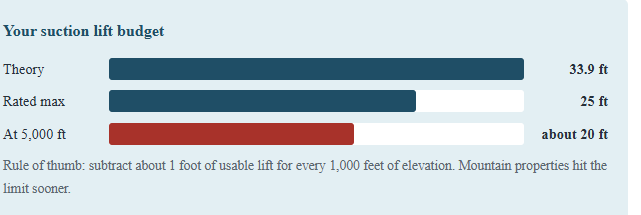
Rule of thumb: subtract about 1 foot of usable lift for every 1,000 feet of elevation. Mountain properties hit the limit sooner.
Is your well really under 25 feet? Measure the right number
The number that matters is not how deep your well is. It’s the vertical distance from the pump down to the water surface while the pump is running, which drillers call the pumping water level. A 60 foot well with water standing at 12 feet can be a great jet pump candidate, while a 20 foot dug well that drops 10 feet under load may not be.
To check yours, drop a weighted tape or a well sounder to the water surface with the pump off. Run water hard for 20 minutes, then measure again, and add the height of the pump above ground level. If that total is over 22 feet, plan for a convertible deep well jet or a submersible instead.
Also check your casing size. Shallow well jet pumps work on almost any casing because only the suction pipe goes into the well, which makes them popular for sand points, driven wells, and dug wells.
A few seasons back we were called to a farmhouse where a brand new 1/2 HP jet pump kept losing prime every afternoon. The owner had measured the well at 19 feet and bought accordingly, which was right on paper. What he hadn’t counted was the pump house, set 70 feet away and 4 feet higher than the wellhead, with a 1 inch suction line and six elbows between them.
By the time friction and elevation were added, the pump was fighting close to 27 feet of effective lift, and the dry season drawdown finished the job. We moved the pump into a small box right beside the wellhead, upsized the suction line to 1¼ inch, and it has held prime ever since.
The 5 best shallow well jet pumps for wells under 25 feet
1. Goulds J5S: best shallow well jet pump overall
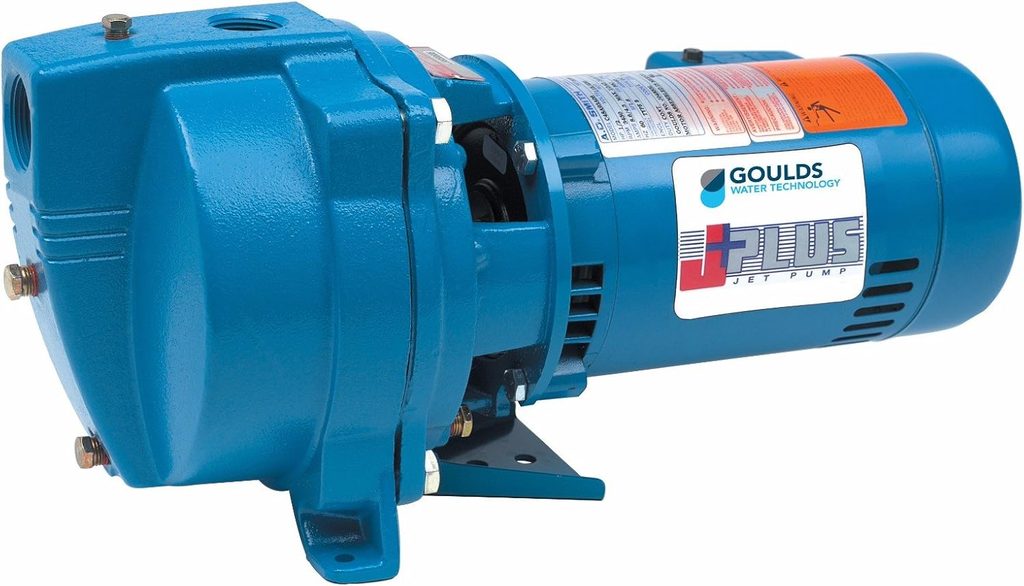
When I pull old jet pumps off failed installations, the Goulds units are the ones that usually just need a seal kit. The J5S is a 1/2 HP cast iron pump from the JS+ line, with a stainless steel shaft, a glass filled composite impeller, and a back pullout design, so you can service the motor and impeller without cutting any pipe.
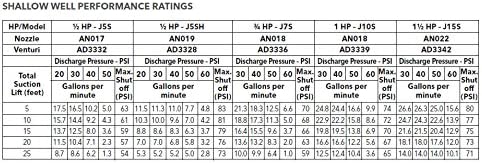
What sets it apart is honest, published performance at every lift. Goulds rates it at 16.5 GPM at 5 feet and 8.6 GPM at 25 feet (both at 30 psi), so you can see exactly what you’ll get from your well. It ships with a factory set 30/50 psi pressure switch and is NSF listed, according to the Goulds JS+ technical brochure and dealer spec sheets.
Goulds J5S: flow drops as lift increases (30 psi)
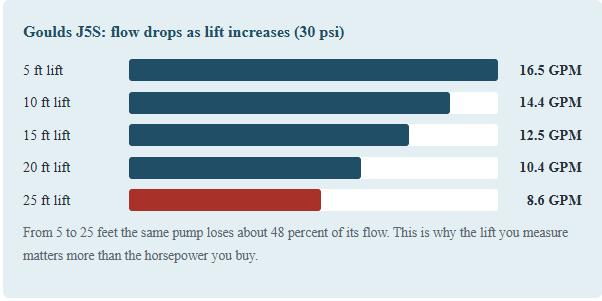
From 5 to 25 feet the same pump loses about 48 percent of its flow. This is why the lift you measure matters more than the horsepower you buy.
- Motor: 1/2 HP, 115/230V, 3,500 RPM
- Suction and discharge: 1¼ inch and 1 inch NPT
- Shutoff pressure: about 63 psi
- Max water temperature: 140°F
- Pressure switch: 30/50 psi preset
- Duty: rated for continuous operation
Pros
- Published flow at every lift depth
- Serviceable without disturbing piping
- Built in overload with auto reset
Cons
- Shorter warranty than Red Lion or Wayne
- Priced above budget brands
Who it’s for: most homes with one to three bathrooms and a pumping level under 20 feet.
2. Red Lion RJS-100-PREM: best for large households and farms
If you’re feeding a bigger house, a livestock trough, and garden hoses from one shallow well, a 1/2 HP pump will leave you short. The RJS-100-PREM steps up to a 1 HP dual voltage motor in a cast iron casing, rated at 23 GPM at 5 feet of lift.
At a more realistic 10 foot lift it still delivers about 21.3 GPM at 30 psi and 15.5 GPM at 40 psi, based on distributor spec listings. It comes with a preset 30/50 switch and a 3 year limited warranty.
- Motor: 1 HP, 115/230V dual voltage
- Flow: 21.3 GPM at 10 ft lift, 30 psi
- Suction and discharge: 1¼ inch and 1 inch NPT
- Impeller: glass filled thermoplastic
- Pressure switch: 30/50 psi preset
- Warranty: 3 years limited
Pros
- Highest flow in this roundup
- Long warranty for the class
- Handles irrigation plus household use
Cons
- Needs a bigger pressure tank to avoid short cycling
- Draws more power than a 1/2 HP unit
Who it’s for: homes with three or more bathrooms, small farms, and properties that irrigate.
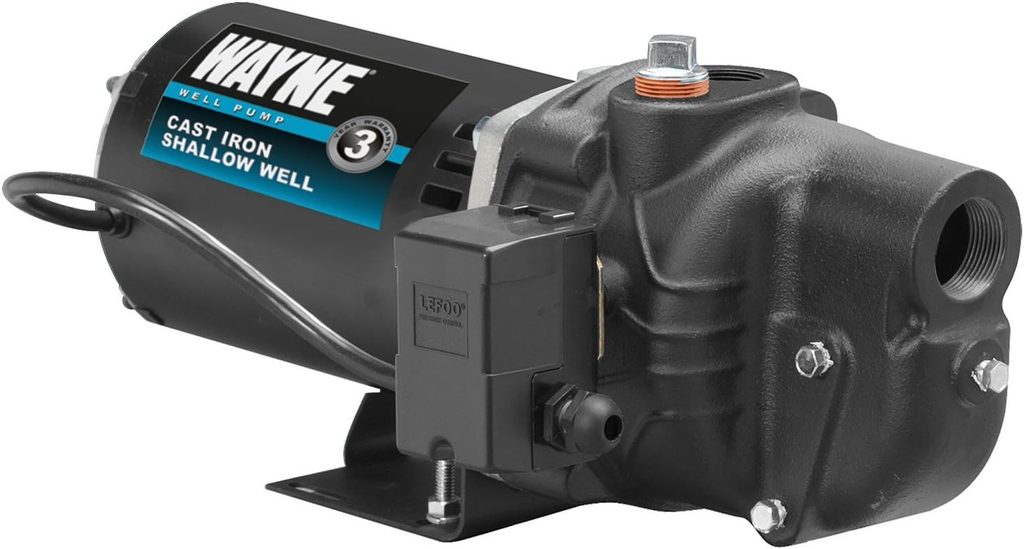
3. Wayne SWS50: best value cast iron pump
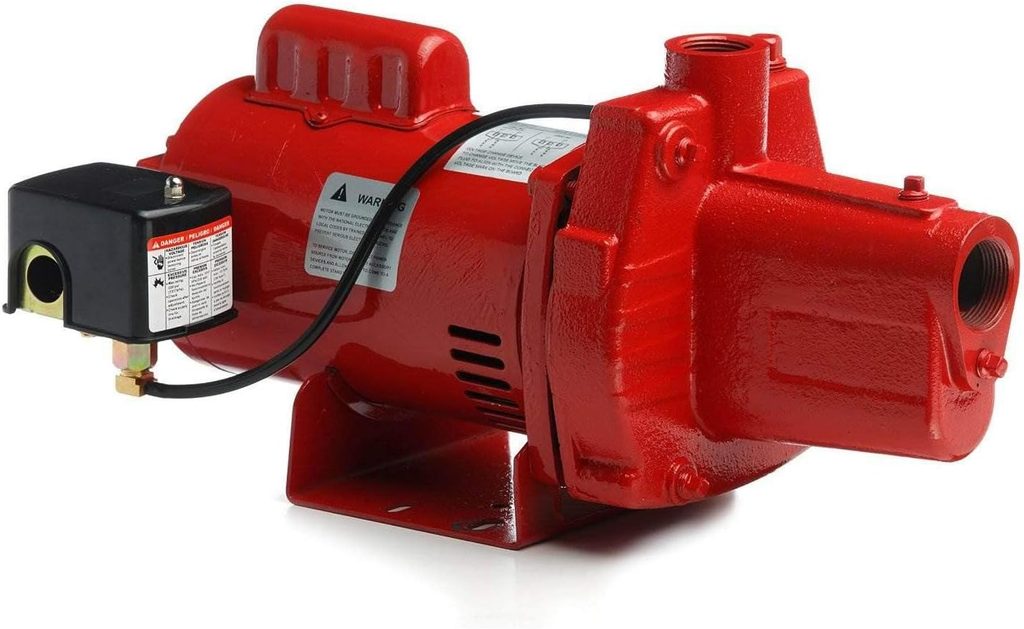
The SWS50 is the pump I’d point a careful budget buyer toward. It pairs a cast iron volute with a reinforced thermoplastic impeller, is assembled in the USA from domestic and imported parts, and carries a 3 year warranty, which beats the Goulds on paper.
Wayne’s own curve data shows about 674 gallons per hour (roughly 11 GPM) at a 5 foot lift and 565 GPH (about 9.4 GPM) at 20 feet, both at 30 psi. It also has a dedicated priming port, which makes first startup a lot less messy.
- Motor: 1/2 HP, 120/240V dual voltage
- Flow: about 9.4 GPM at 20 ft lift, 30 psi
- Suction: 1¼ inch NPT
- Pressure switch: 30/50 psi preset
- Thermal overload protection
- Warranty: 3 years limited
Pros
- Flow holds up well at deeper lift
- 3 year warranty
- Easy priming port
Cons
- Lower top end flow than the Goulds
- Check the voltage selector before wiring
Who it’s for: small to mid sized homes that want cast iron durability at a lower price.
4. Flotec FP4012: best budget pick for corrosive water
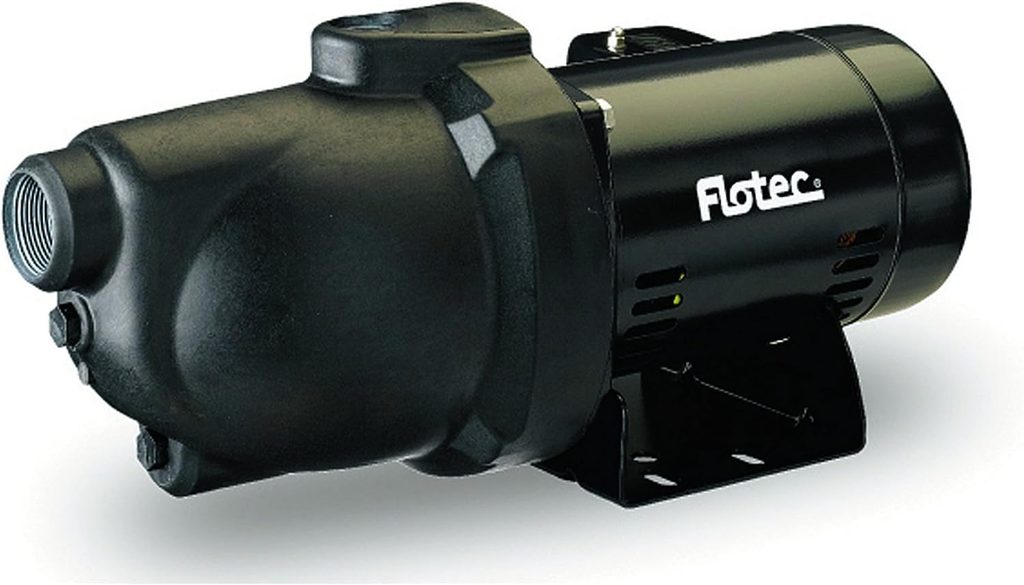
Cast iron is tough, but it rusts in aggressive water. The Flotec FP4012 uses a fiberglass reinforced thermoplastic housing, so it shrugs off low pH and iron heavy water that would scale up a cast iron volute in a few years.
Performance is modest. Pentair rates it at 8 GPM maximum and 6.4 GPM at a 10 foot lift and 40 psi, with a 77 psi maximum pressure and a 1 year warranty.
- Motor: 1/2 HP, 115/230V (preset to 115V)
- Flow: 6.4 GPM at 10 ft lift, 40 psi
- Amp draw: 9.4 A on a 15 amp breaker
- Max pressure: 77 psi
- Housing: thermoplastic
- Warranty: 1 year limited
Pros
- Won’t rust in acidic or iron rich water
- Light (about 23 lb) and easy to mount
- Lowest cost in this list
Cons
- Lowest flow in this roundup
- Only a 1 year warranty
Who it’s for: cottages, one bathroom homes, and wells with known corrosive water chemistry.
5. Wayne SWS50-8.5FX: best all in one kit for cabins
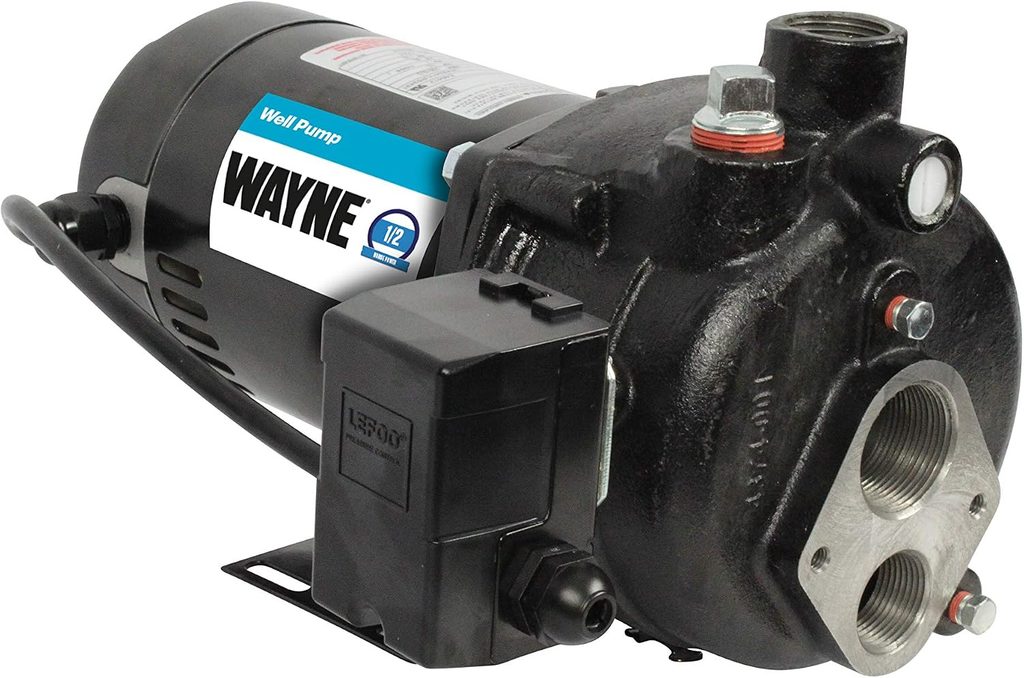
This kit pairs the SWS50 above with an 8.5 gallon precharged pressure tank, so a cabin owner gets pump, tank, and switch in one box. It’s the fastest way to go from a bare sand point to running water, as described on Wayne’s product page.
My honest caveat: 8.5 gallons is small for a full time home. It only holds a couple of gallons of usable water between cycles, so the pump will start often. For weekend use it’s fine, but year round households should buy the bare SWS50 and a properly sized tank.
Pros
- Everything matched in one purchase
- Compact footprint for small pump houses
Cons
- Tank is undersized for full time use
- Frequent cycling shortens switch life
Who it’s for: seasonal cabins, hunting camps, and garden supply wells.
How to size a shallow well jet pump (worked example)
Start with demand. The EPA WaterSense program puts average household use at about 82 gallons per person per day, but pumps are sized for peak flow, not daily totals. A simple field rule is 1 GPM for every fixture likely to run at the same time, which lands most homes between 6 and 12 GPM.
Now take a real case. A family of four has a 2 bathroom home, a pumping water level of 16 feet, and a pump sitting 2 feet above ground right beside the well. Add roughly 2 feet for suction line friction and fittings, and the effective lift is about 20 feet.
At 20 feet the Goulds J5S gives about 10.4 GPM at 30 psi, and the Wayne SWS50 gives about 9.4 GPM. Either covers a 2 bathroom home, while a 4 bathroom home with irrigation would step up to the Red Lion RJS-100-PREM.
| Home size | Peak demand | Suggested pump |
|---|---|---|
| Cabin or 1 bath | 5 to 7 GPM | Flotec FP4012 or Wayne SWS50 |
| 2 to 3 baths | 8 to 12 GPM | Goulds J5S or Wayne SWS50 |
| 3+ baths or irrigation | 12 to 20 GPM | Red Lion RJS-100-PREM |
Then match the tank. A good target is at least 1 gallon of drawdown for every GPM the pump delivers, which gives the motor a minimum one minute run per cycle. Our guide to the best well pressure tanks walks through drawdown at 30/50 and 40/60 settings.
Installation rules that keep a jet pump alive
Nearly every jet pump I’ve replaced early failed for one of the same few reasons. Get these right and a decent pump will run for a decade or more.
- Keep the pump close to the well. Every foot of horizontal suction line and every elbow adds friction that counts against your 25 foot limit.
- Use the full 1¼ inch suction size. Never reduce the suction line below the pump’s inlet size, and go to 1½ inch on long horizontal runs.
- Install a quality foot valve. It holds the water column in the line so the pump stays primed between cycles; a leaky one is the top cause of lost prime.
- Seal every suction joint. A pinhole leak on the suction side lets air in and the pump will run without moving water.
- Prime before first start. Fill the casing and suction line completely, because running dry destroys the mechanical seal in minutes.
- Protect from freezing. A jet pump lives above ground, so use an insulated pump house or a heat source in cold climates.
Jet pump or submersible for a shallow well?
Jet pumps win on shallow wells because they’re cheaper, easy to reach for service, and fit small or driven wells where a submersible can’t go. They lose on efficiency, since some of their output is always recirculated through the jet, and they’re noisier because the motor sits in or near the house.
Choose a submersible if your pumping level is near or past 22 feet, your water level drops a lot in dry months, or you want off grid power. For solar setups, see our roundup of solar submersible water pumps and run your numbers through the solar pump sizing calculator.
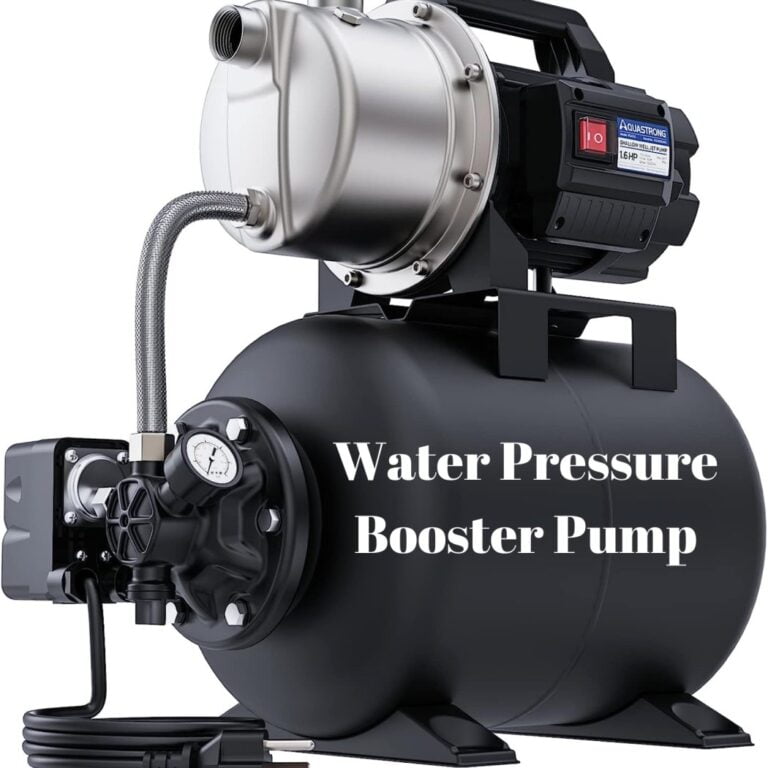
If your jet pump is working but the pressure at upper floor showers still feels weak, a booster may be the cheaper fix. Our water pressure booster pump guide covers when that makes sense.
Common shallow well jet pump problems and quick fixes
Pump runs but won’t build pressure. Look for an air leak on the suction side, a stuck foot valve, or a pumping level that has dropped past the pump’s lift. Measure the water level before replacing parts.
Pump loses prime overnight. The foot valve or check valve is leaking back. Replace it rather than repriming every morning, because each dry start wears the seal.
Pump clicks on and off rapidly. That’s short cycling, usually from a waterlogged or undersized pressure tank. Check the tank’s air precharge with the power off; it should sit 2 psi below the cut in pressure.
Frequently asked questions
What is the maximum depth for a shallow well jet pump?What size shallow well jet pump do I need for my house?Do shallow well jet pumps need a foot valve?How long does a shallow well jet pump last?Can a jet pump be installed inside the house?
The bottom line
For most wells with water under 25 feet, the Goulds J5S is the pump I’d install first, because its published flow data lets you know exactly what you’re getting. Big households should go with the Red Lion RJS-100-PREM, and buyers watching cost will be well served by the Wayne SWS50.
Whatever you choose, measure your pumping water level before you buy, keep the pump close to the well, and pair it with a correctly sized pressure tank. Those three steps matter more than the brand name on the motor. Browse more well water equipment guides to finish the rest of your system.
Also Read On: >>>Grundfos CMBE 3-62 Booster Pump