Best Iron Filters for Well Water in 2026
Orange rings in the toilet. Rust streaks down the tub. Laundry that comes out of the wash looking worse than it went in.
If you own a private well, you probably know the look. Iron is the complaint I hear more than any other, and it is also the one people waste the most money trying to fix.
After more than a decade drilling wells, I see the same pattern. Someone buys a filter that was never built for their iron level, it clogs within a month, and they decide iron filters do not work. They do work, as long as you match the filter to your water.
This guide covers the best iron filters for well water in 2026, how each type works, and the sizing math most reviews skip.
Boreholeflow is reader supported. If you buy through links on this page, we may earn a commission at no extra cost to you. Read our disclosure.
The best iron filters for well water at a glance
| Filter | Best for | Rated iron | Type |
|---|---|---|---|
| AFWFilters AIS10-25SXT | Best overall | Up to 8 ppm | Air injection |
| AFWFilters Air Injection Platinum 1.5 | High iron and sulfur | Up to 12 ppm | Air injection, catalytic media |
| iSpring WGB32BM | Best budget | Up to 3 ppm | Three stage cartridge |
| AFWFilters Iron Pro 2 | Iron plus hard water | Low to moderate | Softener with fine mesh resin |
| Home Master HMF3SDGFEC | Light iron, strong flow | Up to 3 ppm combined | Three stage cartridge |
Why iron is the number one well water complaint
Roughly 43 million , about 15 percent of the population, drink water from a private well. The EPA does not regulate any of those wells. That makes you the water utility.
Iron is one of the most common elements in rock and soil, so groundwater picks it up almost everywhere. The EPA secondary standard for iron is 0.3 mg/L, which is the same as 0.3 parts per million (ppm). Above that level you start to see rusty color, sediment, metallic taste, and reddish or orange staining.
That standard is one of 15 guidelines the EPA sets for taste, color, and odor. It is not a health limit, but iron is an expensive nuisance.
Here is why. A family that uses 300 gallons a day with 3 ppm iron sends about 2.7 pounds of iron through the plumbing every year. That iron settles in the water heater, coats the pressure tank, narrows pipes, and stains everything it touches.
Manganese often travels with iron and leaves black or brown stains instead of orange ones. The EPA guideline for manganese is far lower at 0.05 mg/L. In USGS sampling from 1991 to 2010, 7 percent of wells tested above 0.3 mg/L of manganese, which is the health based screening level.
The three types of iron in well water
Not all iron behaves the same way. The type you have decides which filter will work.
Ferrous iron (clear water iron)
Ferrous iron is fully dissolved. The water runs clear from the tap, then turns orange after it sits in a glass for a few minutes. This is the most common type in deep drilled wells.
Ferric iron (red water iron)
Ferric iron has already reacted with oxygen and turned into rust particles. The water looks orange or cloudy the moment it leaves the faucet. A sediment filter can catch some of it, but it loads up fast.
Iron bacteria and organic iron
Iron bacteria feed on iron and leave a slimy reddish film. Lift the lid on your toilet tank, and if you see a jelly like coating or an oily sheen, bacteria are likely involved. A filter alone will not solve this, so plan on shock chlorination or chemical injection first.
Test your water before you buy
I will not specify a filter without a lab report, and you should not buy one without it either. You need five numbers: iron, manganese, pH, hardness, and hydrogen sulfide.
A state certified lab is the most reliable route. The UMass Amherst fact sheet on iron and manganese in private wells explains what to ask for and how to read the results.
The pH number matters more than most people expect. Air injection filters work best when pH sits at 7.0 or higher. Acidic water slows the reaction that turns dissolved iron into a particle the filter can trap.
How iron filters work and which type you need
Every iron filter does the same two jobs. It converts dissolved iron into a solid, then it traps that solid. The methods differ in how much iron they can handle.
| Treatment method | Works up to (iron plus manganese) | Upkeep |
|---|---|---|
| Cartridge iron filter | About 3 ppm | New cartridges every 6 to 12 months |
| Water softener (ion exchange) | Under 5 mg/L | Salt, plus resin cleaner |
| Oxidizing filter (greensand and similar media) | Under 15 mg/L | Backwash, media every 5 to 10 years |
| Pressure aeration (air injection) | Under 25 mg/L | Automatic backwash, no chemicals |
| Chemical oxidation plus filtration | Above 10 mg/L | Chlorine or peroxide refills |
Those limits come from university extension guidance. Individual products are rated lower, so check each model against your lab result.
Maximum rated iron by filter (ppm)
iSpring WGB32BM3 ppm
Home Master HMF3SDGFEC3 ppm
AFWFilters AIS10-25SXT8 ppm
AFWFilters Air Injection Platinum 1.512 ppm
Size the filter to your well, not just your house
This is the step that separates a filter that lasts 10 years from one that fails in 10 months. A backwashing filter cleans itself by running water backward through the media bed. If your pump cannot deliver enough flow, the bed never lifts and the iron stays put.
As a rule of thumb, a 10 inch tank needs about 5 to 7 gallons per minute (GPM) to backwash. A 12 inch tank needs about 7 to 10 GPM. Heavier catalytic media sits at the top of those ranges.
The bucket test
1. Open a hose spigot near the pressure tank and let the pump kick on.
2. Time how long it takes to fill a 5 gallon bucket.
3. Gallons divided by seconds, times 60, equals GPM.
Example: 5 gallons in 40 seconds is 7.5 GPM. That pump can backwash a 10 inch tank with room to spare, but it is marginal for a 12 inch tank.
If your flow comes up short, the pump may be worn or undersized. Our guide to the best electric water pumps covers replacement options.
Solar pumps deserve extra care because many deliver only 2 to 5 GPM. Run your numbers through the solar pump sizing calculator before you commit to a backwashing filter. Our solar submersible pump reviews list flow rates for the popular models.
The 5 best iron filters for well water reviewed
Best overall
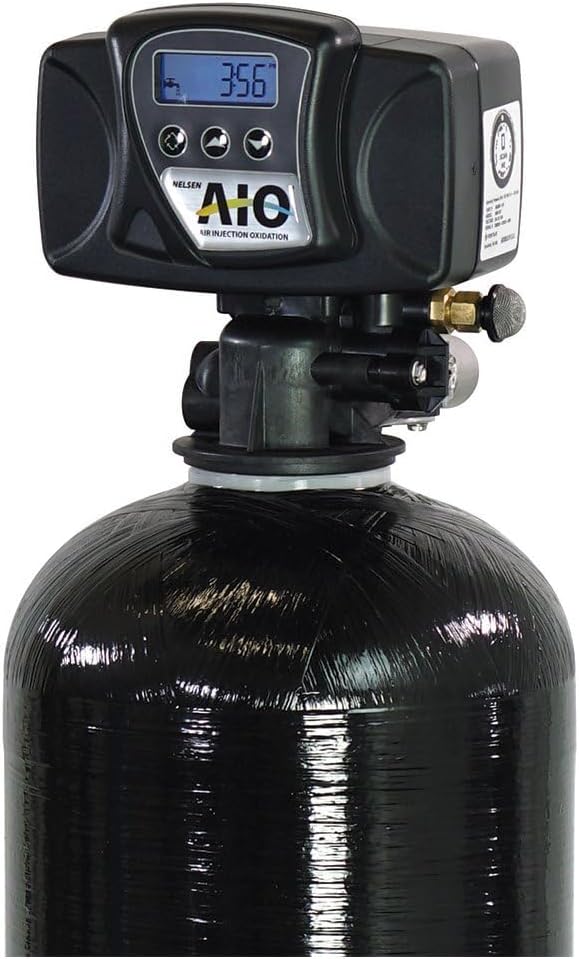
1. AFWFilters AIS10-25SXT Air Injection Iron Filter
- Rated iron: up to 8 ppm
- Also treats: hydrogen sulfide up to 6 ppm, manganese up to 3 ppm
- Service flow: 10 to 12 GPM
- Warranty: 5 years on the valve, lifetime on the tank
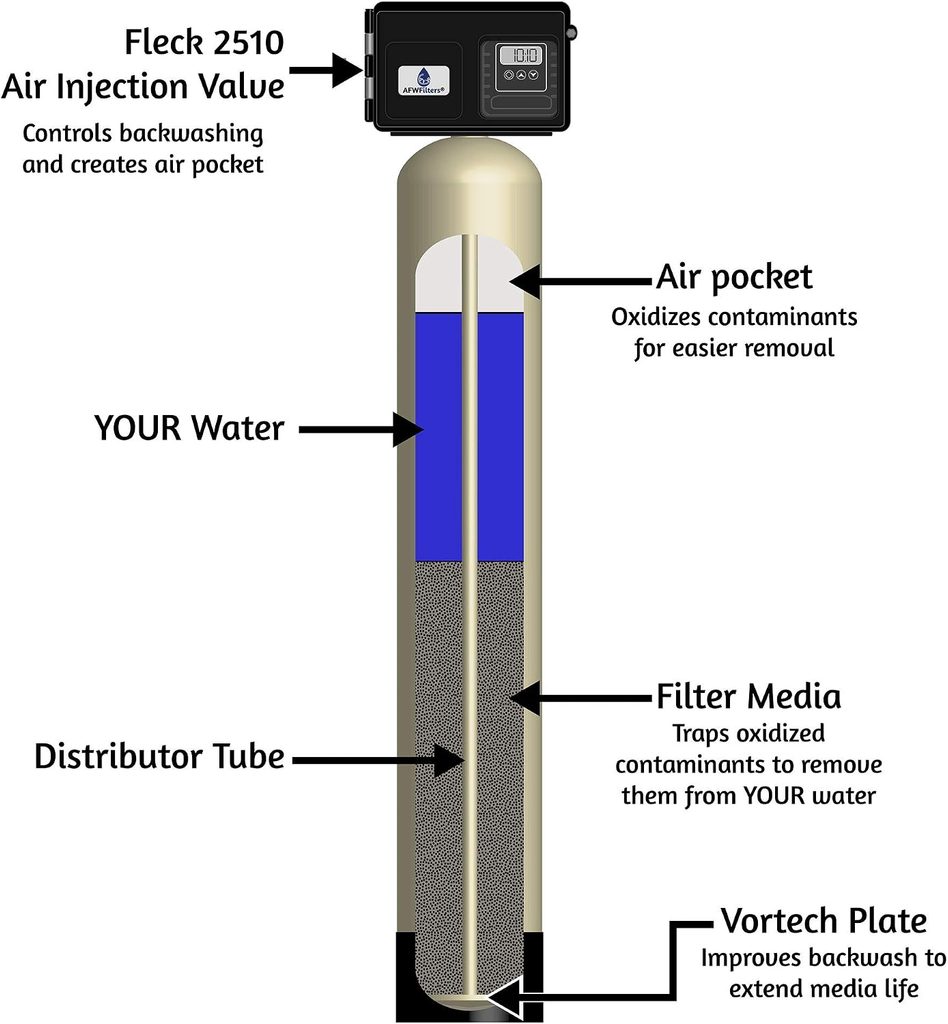
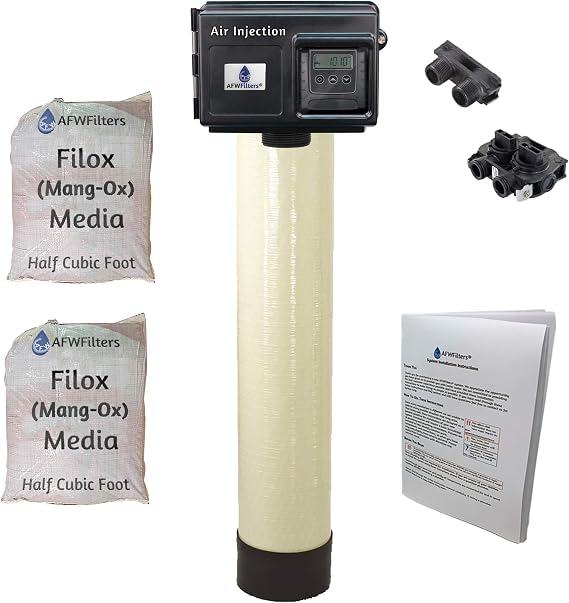
This is the filter I would put on most wells with moderate iron. It holds a pocket of air at the top of the tank, which converts dissolved iron into particles as water passes through. The media bed below traps them, and the valve flushes everything to drain on a schedule you set.
There are no chemicals to buy and no cartridges to change. Expect to pay roughly $700 to $900.
Skip it if: your pump delivers under 5 GPM or your pH is below 6.8.
Best for high iron and sulfur
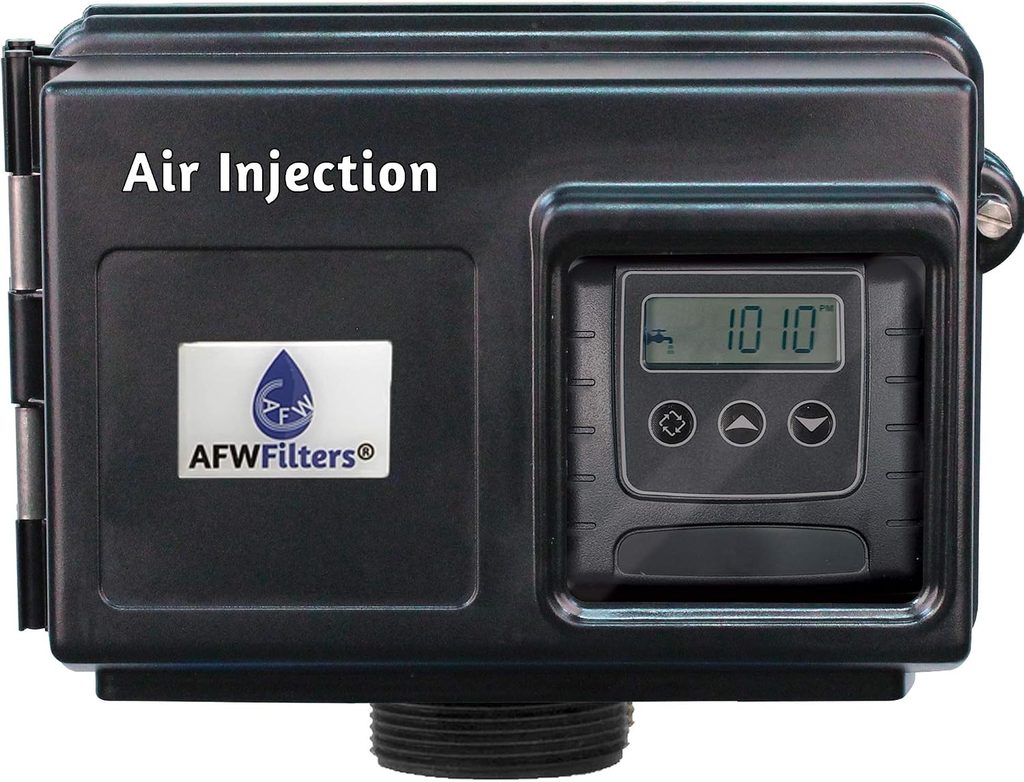
2. AFWFilters Air Injection Platinum 1.5 Cubic Foot
- Rated iron: up to 12 ppm
- Also treats: hydrogen sulfide up to 10 ppm, manganese up to 5 ppm
- Service flow: 10 to 12 GPM
- Warranty: 5 years on the valve, lifetime on the tank
When the lab report shows iron in the high single digits, or the water smells like rotten eggs, this is the upgrade. It uses the same air injection principle with a larger bed of catalytic media. That media reacts faster and holds more iron between backwash cycles.
The catch is flow. This heavier media needs a strong backwash, so confirm your pump can deliver 7 GPM or more. Pricing runs roughly $1,150 to $1,500.
Skip it if: your iron is under 5 ppm, because the smaller unit above will do the job for less.
Best budget
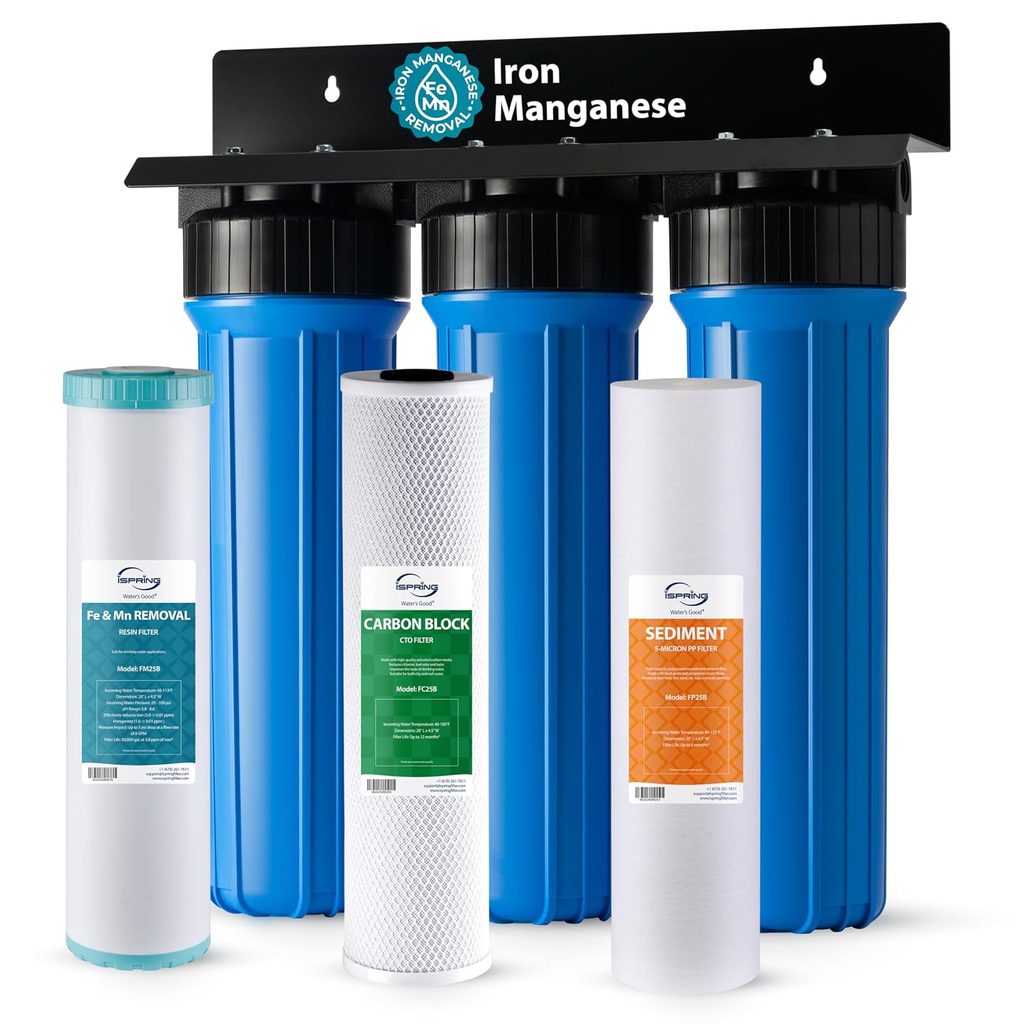
3. iSpring WGB32BM Three Stage Whole House Filter
- Rated iron: up to 3 ppm
- Also treats: manganese up to 1 ppm, sediment, chlorine taste
- Service flow: up to 15 GPM
- Capacity: about 100,000 gallons per cartridge set
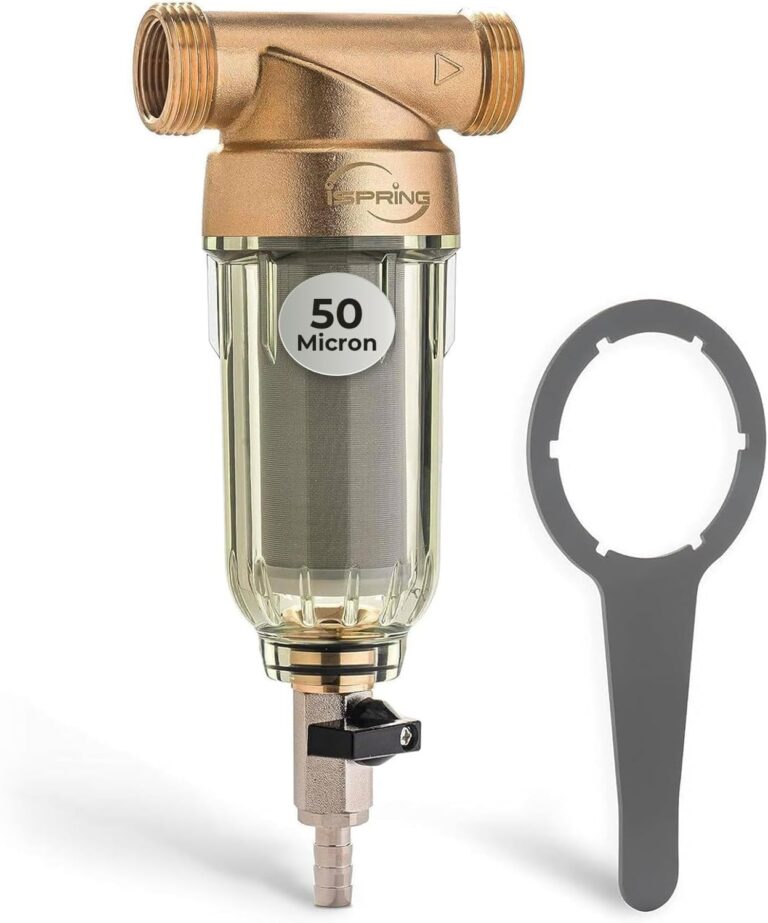
The iSpring is the cheapest way to deal with light iron. Water passes through a sediment cartridge, a carbon block, and then a dedicated iron and manganese cartridge. It needs no drain line and no power.
At 300 gallons a day, 100,000 gallons works out to about 11 months. Push it past 3 ppm, though, and the iron cartridge will clog in weeks. Hard water also shortens its life, so iSpring advises a softener ahead of it in that case.
Skip it if: your iron tests above 3 ppm.Check price on Amazon
Best for iron plus hard water
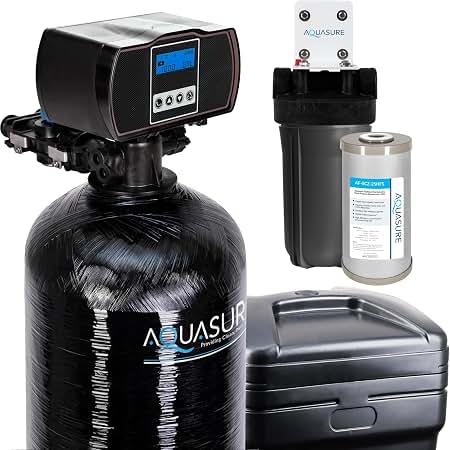
4. AFWFilters Iron Pro 2 Combination Softener
- Type: water softener with fine mesh resin
- Treats: hardness plus dissolved (ferrous) iron
- Best range: low to moderate iron with hardness of 7 grains per gallon or more
- Needs: salt, a drain line, and a power outlet
Many wells have iron and hard water together. The Iron Pro 2 handles both in a single tank. Its fine mesh resin grabs dissolved iron along with the calcium and magnesium that cause scale.
It only works on clear water iron. Rust particles and iron bacteria will foul the resin. Add a resin cleaner to the salt tank every few months to keep it working.
Skip it if: your water runs orange straight from the tap. For iron above about 3 ppm, I prefer an air injection filter ahead of a standard softener.Check price on Amazon
Best cartridge alternative
5. Home Master HMF3SDGFEC Three Stage Filter
- Rated load: up to 3 ppm of iron, manganese, and sulfur combined
- Service flow: up to 15 GPM
- Capacity: about 95,000 gallons
- Install: wall mount, no drain, no power
The Home Master competes directly with the iSpring. Its oversized housings and 1 inch ports keep pressure loss low, which matters in a home with three bathrooms. The first stage sediment filter has four layers, so it lasts longer on gritty wells.
Pay attention to the word combined in the rating. If you have 2 ppm iron and 1 ppm sulfur, you are already at its limit.
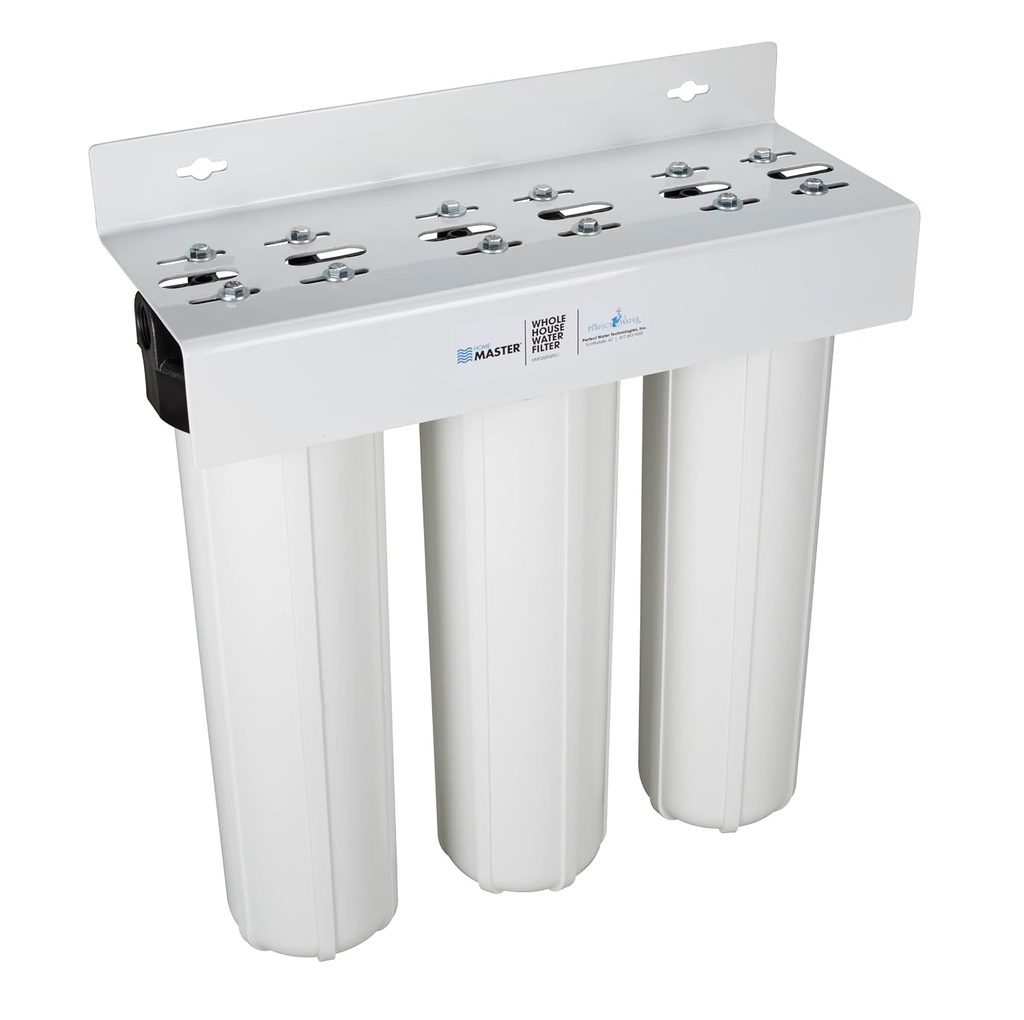
Skip it if: your combined iron, manganese, and sulfur exceed 3 ppm.
A field story: the cartridge that lasted three weeks
A homeowner called me about a filter that “stopped working.” He had installed a three stage cartridge system himself, and for the first two weeks the water was perfect. By week three the pressure in the shower had dropped to a trickle.
We pulled a sample and sent it to a lab. His iron came back at 6.4 ppm, more than double the 3 ppm rating on the cartridge. The filter was not faulty, it was simply full.
He was spending about $90 a month on replacement cartridges. We swapped in an air injection filter, kept his cartridge housing as a sediment prefilter, and set the backwash for every third night. Two years later the toilets are still white, and his only cost is a few gallons of backwash water.
What iron filters cost to buy and run
| System type | Typical unit cost | Ongoing cost |
|---|---|---|
| Three stage cartridge | $400 to $600 | New cartridge set every 6 to 12 months |
| Air injection, 1.0 cubic foot | $700 to $900 | Backwash water, media every 5 to 10 years |
| Air injection, 1.5 cubic foot catalytic | $1,150 to $1,500 | Backwash water, media every 5 to 10 years |
| Softener with fine mesh resin | $700 to $1,000 | Salt and resin cleaner |
Prices shift often, so treat these as rough ranges. A plumber will usually charge a few hundred dollars to install a backwashing filter.
Install the filter after the pressure tank and before the water heater. If you also run a softener, the iron filter goes first.
Frequently asked questions
What is the best iron filter for well water?
For most homes with 3 to 8 ppm iron, an air injection filter such as the AFWFilters AIS10-25SXT is the best choice. It uses no chemicals and cleans itself. For iron under 3 ppm, a cartridge system such as the iSpring WGB32BM costs less.
How much iron in well water is too much?
The EPA guideline is 0.3 mg/L, or 0.3 ppm. Staining and metallic taste begin around that level. Most homeowners decide to treat once iron passes 1 ppm.
Will a water softener remove iron?
A softener removes small amounts of dissolved iron, generally under 3 ppm in practice. It will not remove rust particles or iron bacteria. Heavy iron fouls the resin and shortens its life.
Is iron in well water harmful to drink?
Iron at typical well levels is considered a nuisance, not a health risk. The EPA standard for iron is based on taste, color, and staining. Manganese is different, so test for it at the same time.
The bottom line
Iron is the most common well water complaint, and it is also one of the most fixable. Test your water, measure your pump flow, and then buy the filter rated for both numbers.
For most wells, that means an air injection system like the AFWFilters AIS10-25SXT. Light iron calls for the iSpring WGB32BM, and heavy iron calls for the Platinum 1.5.
Want more gear advice from someone who installs it for a living? Browse the rest of our well water equipment guides.
Also Read On:
>>>https://boreholeflow.com/uv-water-purifiers-for-small-homes/