Best Water Level Meters and Well Sounders: A Driller’s Picks for Home Wells (2026)
Most well owners know their pump brand and tank size, but not the one number that shows whether the well itself is healthy. That number is the depth to water, and the best water level meters let you check it in about five minutes.
The U.S. Geological Survey estimates that more than 43 million Americans, about 15 percent of the population, drink from private wells. Federal drinking water rules do not cover those wells, so monitoring falls to the owner.
I have spent more than a decade drilling and test pumping boreholes. Here are the meters I trust, the accuracy data behind them, and a simple routine for reliable readings.
This article may contain affiliate links, and we may earn a commission from purchases made through those links. For more information, please refer to our disclosure.

Quick Picks: Best Water Level Meters at a Glance
| Meter | Type | Best for | Price tier |
|---|---|---|---|
| Solinst 101 P7 | Electric tape | Best overall accuracy | $$$ |
| Eno Scientific Well Sounder 2010 PRO | Sonic | No contact readings and pump test logging | $$$$ |
| Solinst 101B | Electric tape | Best value from a pro brand | $$ |
| Heron Skinny Dipper | Electric tape | Crowded or narrow casings | $$ |
| Solinst Sonic Water Level Meter | Sonic | Fast checks across many wells | $$$$ |
| Generic steel tape dip meter | Electric tape | Tight budgets and shallow wells | $ |
Prices change with tape length and seller. Pro tapes usually run from about $600 for a 100 foot reel to around $1,000 for 300 feet, so confirm the current price before you order.
Why Every Well Owner Should Measure Water Level
Your submersible pump only works while it stays under water. When the level drops close to the intake, the pump draws air, overheats, and fails early. A water level meter warns you early, alongside the well pump protection devices we recommend.
Water level also tells you how much reserve you have in the casing. If your water column shrinks by 50 feet in a 6 inch well, you have lost about 73 gallons of storage.
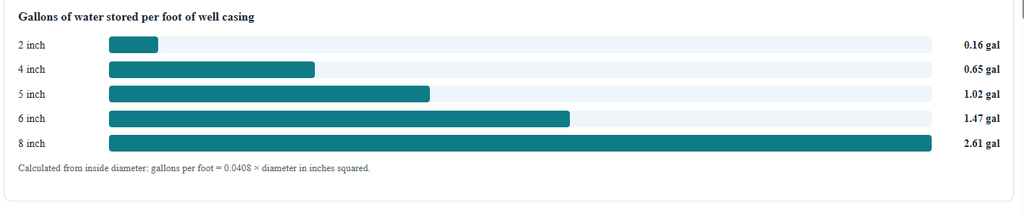
Calculated from inside diameter: gallons per foot = 0.0408 × diameter in inches squared.
Three terms to know. Static water level is the depth to water after the pump has been off for a while. Pumping water level is the depth while the pump runs, and drawdown is the difference between the two.
You need these numbers to size equipment, and you can enter them straight into our solar pump sizing calculator. They also explain low pressure often blamed on the well pressure tank or mistaken for the signs your well pump is going bad.
Electric Tape or Sonic Well Sounder: Which Type Is Right?
An electric tape is a marked flat tape on a reel with a metal probe at the end. When the probe touches water it completes a circuit, the reel beeps and lights up, and you read the depth at the top of the casing.
A sonic well sounder sends a sound pulse down the casing and times the echo off the water surface. Nothing touches the water, and a reading takes about a second. Sounders cost more but shine in crowded casings.
| Feature | Electric tape | Sonic sounder |
|---|---|---|
| How it reads | Probe closes a circuit at the water | Times a sound echo |
| Typical resolution | 1/100 of a foot | About 1/10 of a foot |
| Enters the well water | Yes, clean it first | No |
| Crowded casings | Can snag on wire and rope | Works through a vent hole |
| Data logging | Rarely | Often built in |
| Can measure total well depth | Yes, with a submersible probe | No |
What the USGS Found When It Tested Popular Tapes
Is a tape marked to 1/100 of a foot really that accurate? The USGS tested this in Accuracy Testing of Electric Groundwater Level Measurement Tapes. Researchers compared three new units each from six brands, including Solinst, Heron, and In Situ, against a calibrated steel reference tape.
None of the models consistently hit the ±0.01 foot standard, and the authors concluded that an uncalibrated tape should be trusted to roughly ±0.05 feet per 100 feet. Most tapes also measured slightly short, which makes the water look deeper than it really is.

Source: USGS Open File Report 2014/1236, Table 3. Durham Geo is left out because its units varied the most.
Two of the three Solinst tapes stayed within 0.01 feet over their full 300 foot length, the best result in the study. For a home owner tracking trends, ±0.05 feet is still more precise than you need.
The 6 Best Water Level Meters and Well Sounders Reviewed
1. Solinst 101 P7 Water Level Meter
Best overall
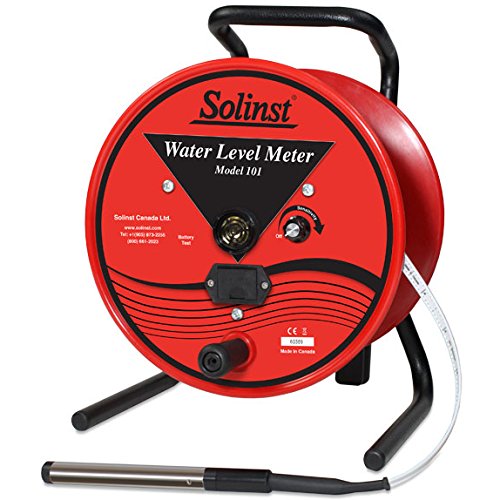
The Solinst 101 is the meter you will find in most drilling trucks, and the USGS data backs that reputation. Its flat tape is laser marked every 1/100 of a foot and traceable to national standards.
The P7 probe can be submerged the full length of the tape, which means you can measure total well depth as well as water level. Solinst also sells spare probes and tape, so this is a tool you repair rather than replace.

2. Eno Scientific Well Sounder 2010 PRO
Best sonic well sounder
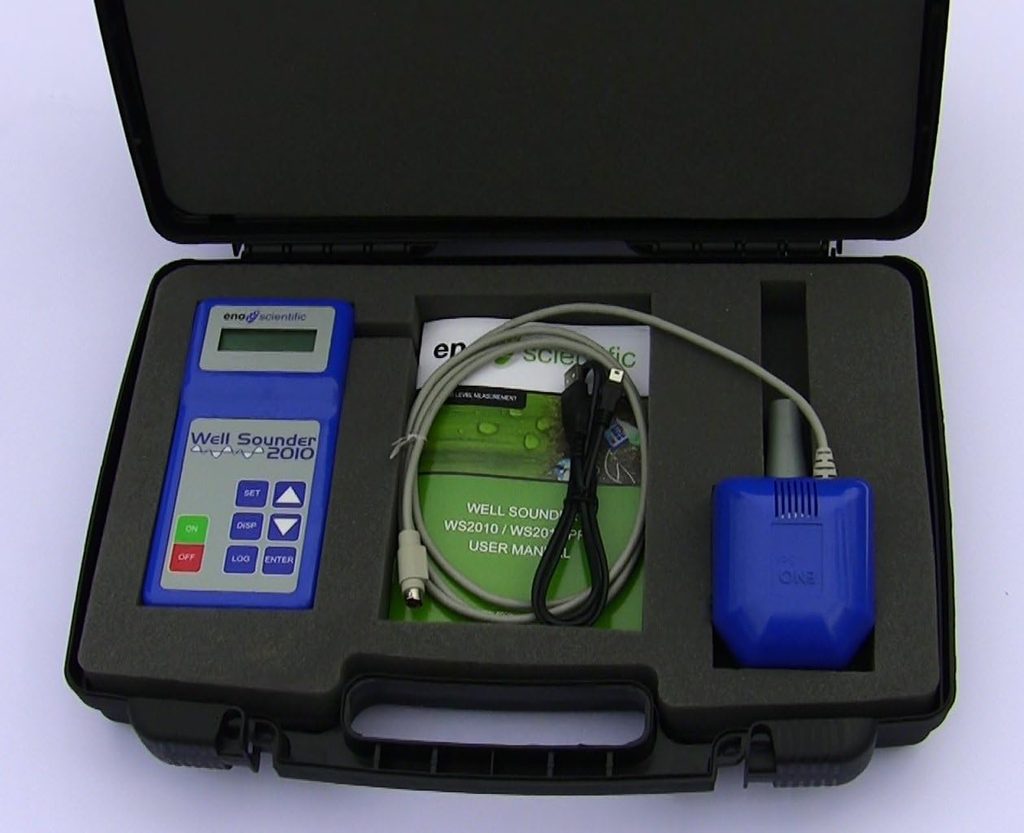
The Well Sounder 2010 PRO is the best known sonic meter for home and professional wells. You seat the probe in the well cap vent and switch it on, and the static level appears within seconds.
The feature I value most is the built in data logger, which stores millions of time stamped readings. Add a flow meter and it runs an unsupervised drawdown test. Details are on the Eno Scientific product page.
One caution: it is not waterproof, and methane in a well can throw off the echo.

3. Solinst 101B Water Level Meter
Best value
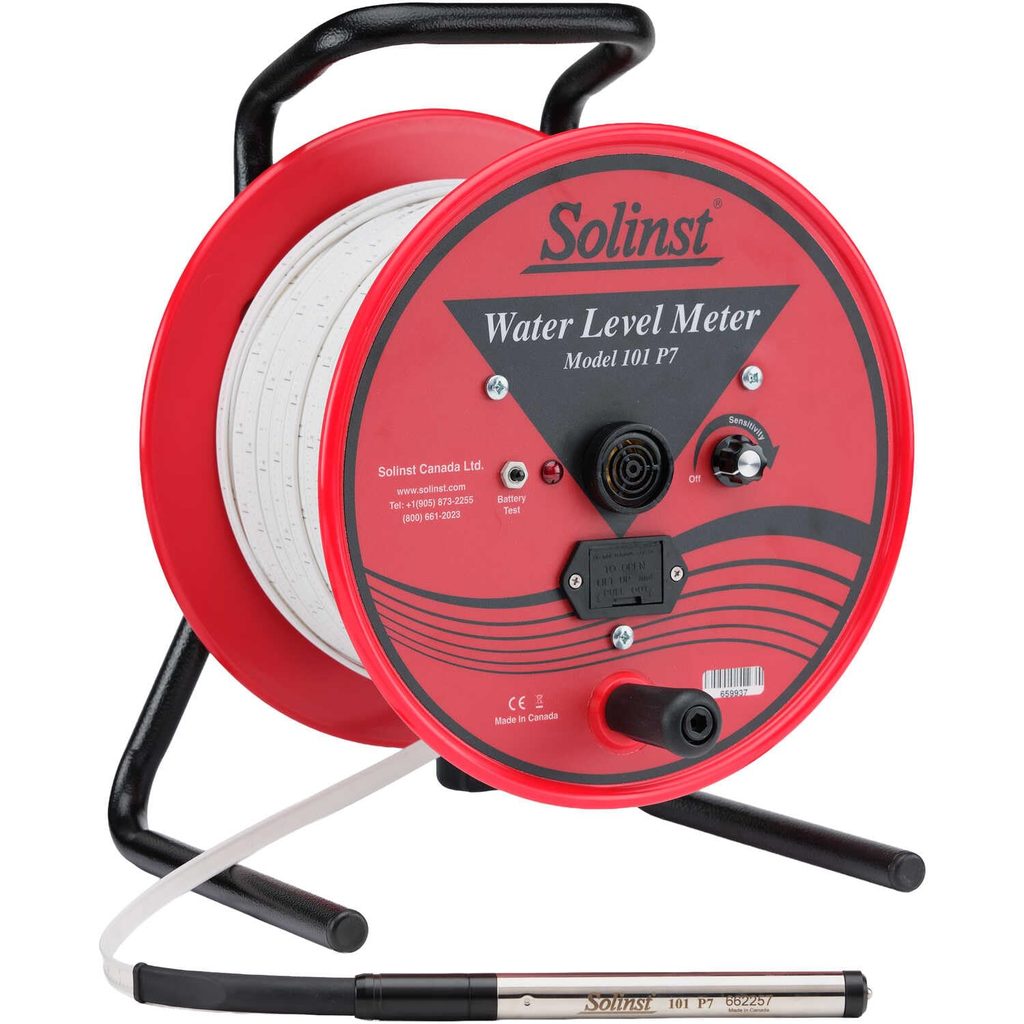
The 101B is the basic version of the Solinst 101. You keep the marked flat tape and signal, but give up the fully submersible probe.
For a home owner who checks one well a few times a year, that trade makes sense. Buy a tape at least 50 feet longer than your pump setting depth so you can follow the level down in a dry summer.

4. Heron Skinny Dipper
Best for tight wells
Home wells are crowded, with drop pipe, pump cable, and safety rope all sharing a 4 or 6 inch casing. The Heron Skinny Dipper uses a slim probe designed to slip past that clutter. In a USGS field check, bulky probes could not pass the access port on some wells.
Heron is the main rival to Solinst, and its tapes performed consistently in the USGS test. A breakaway link sacrifices a snagged probe to save the tape.

5. Solinst Sonic Water Level Meter
Best for many wells
This handheld unit is the Solinst answer to the Eno sounder, with nothing to clean between wells. It is the priciest option here and suits farms or anyone checking several wells in one trip.

6. Generic Steel Tape Dip Meter
Budget pick
Amazon carries many unbranded dip meters with 100 to 500 foot tapes, often for under $150.
They are fine for a shallow well and occasional checks. Check the tape against a steel measuring tape before you trust it.

How to Choose the Right Water Level Meter
Start with depth. Pull your well log and note the total depth and the pump setting. Your tape should reach at least 50 feet past the pump, and a sonic unit should be rated well beyond it.
Check your access. A tape needs a clear path, ideally a dedicated sounding tube. If your cap only has a small vent, a sonic sounder is the easier choice, and our guide to well caps and sanitary seals covers caps with a proper measuring port.
Match precision to the job. For trend tracking, a tenth of a foot is plenty. For a formal pump test or a dispute with a driller, use a quality tape and calibrate it against a steel tape as the USGS recommends.
Protect your water. Anything lowered into a well can carry bacteria. A USGS survey of about 2,100 private wells found roughly one in five already had a contaminant above a health benchmark, so do not add to the problem. See the EPA private wells page for testing advice.
How to Measure Static Water Level in 6 Steps
- Rest the well. Switch off the pump and avoid using water for at least two hours. Overnight is better.
- Clean the probe. Wipe the probe and the first few feet of tape with a mild chlorine solution, then rinse with clean water.
- Mark a measuring point. Use the same spot on top of the casing every time and mark it with paint.
- Lower slowly. Feed the tape down until the buzzer sounds, then raise and lower it a few inches to find the exact point.
- Read and repeat. Read the tape at your mark and take a second reading. The two should agree within 0.02 feet.
- Record it. Write down the date, time, depth, and how long the pump was off.
From the Field: The Pump That Was Set Too Shallow

How Often Should You Check Your Well?
Measure at least four times a year, once each season. Add a reading at the end of every dry spell, because that is when levels sit lowest.
Log every reading; a decline of a few feet each year is an early warning. That low season figure is also the one to use when sizing submersible pumps for deep wells, solar submersible pumps, or water storage tanks for well systems.
Frequently Asked Questions
What is the difference between a water level meter and a well sounder?
Both measure depth to water. A water level meter usually means an electric tape with a probe, while a well sounder usually means a sonic unit that never touches the water.
How accurate are water level meters?
Quality tapes are marked to 1/100 of a foot. A USGS test found uncalibrated tapes accurate to roughly ±0.05 feet per 100 feet, which is more than enough for home monitoring.
Will a water level meter contaminate my well?
Not if you clean it first. Wipe the probe and tape with a mild chlorine solution before each use, or choose a sonic sounder so nothing enters the water.
Why does my tape not beep when it reaches the water?
Electric tapes rely on dissolved minerals to complete the circuit. Very pure water, a weak battery, or a low sensitivity setting can all stop the signal, so test the battery and turn up sensitivity first.
Final Verdict
For most well owners, the Solinst 101 P7 is the best water level meter you can buy. It posted the best tape accuracy in USGS testing. If budget matters more, the Solinst 101B gives you most of that quality for less.
If your casing is crowded or you want logged pump test data, choose the Eno Scientific Well Sounder 2010 PRO. For backup water when the power goes out, see our guides to the best generator for a well pump and the best hand pumps for wells.
Also Read On:
👉Best Well Caps, Sanitary Seals, and Vermin Proofing for Private Wells
👉Best Cistern and Water Storage Tanks for Well Systems (2026 Buyer’s Guide)
👉9 Signs Your Well Pump Is Going Bad: Catch Pump Problems Early Before You Lose Water Completely