Pump Cycle Counter and Lifespan Estimator: How Many Years Does Your Well Pump Have Left?
Every time your well pump kicks on, it takes a small bite out of its own life. A pump that starts 15 times a day can run for 20 years, while the same pump starting 300 times a day may be finished in two. This free well pump lifespan calculator works as a pump cycle counter and lifespan estimator, so you can see which of those futures your system is heading toward.
After more than a decade drilling boreholes and commissioning pump systems, I can tell you that most pumps do not die of old age. They die from starts. Let’s count yours.
This post contains affiliate links. If you buy through them we may earn a small commission at no extra cost to you. Read our disclosure.

Why Pump Cycles Matter More Than Pump Age
A submersible motor draws roughly three to six times its running current for a split second when it starts. That inrush heats the windings, twists the shaft, and slams the thrust bearing. Do that too often and the heat never has time to leave.
Motor manufacturers are blunt about this. Franklin Electric’s AIM manual sets a hard ceiling on starts per 24 hours, and the numbers are lower than most homeowners expect.

Here is the catch. Those figures are the absolute maximum, not a healthy target. Running a pump near its ceiling every day is like redlining a truck engine on every trip to the store.
The Statistics Every Well Owner Should Know

According to the EPA’s private domestic well estimates, about 23 million housing units rely on private wells. That figure has grown by more than 50 percent since 1990, when roughly 15.1 million households used wells. Every one of those homes has a pump quietly counting starts.
The pump specialists at R.C. Worst put average life at 10 to 15 years for three wire submersibles and 8 to 13 years for two wire models. They also report that a pump cycling 50 or more times a day should be expected to last under 10 years. In their cycling case study, a quiet household at about 10 starts a day could see 15 to 30 years, while a home pushed past 300 starts a day would struggle to reach two.

Field estimates compiled from R.C. Worst pump service data. Actual life also depends on sediment, voltage, and motor quality.
Pump Cycle Counter and Lifespan Estimator
Enter what you know about your system below. If you do not know your daily water use, start with 300 gallons for a family of four and adjust from there.
Well Pump Lifespan Calculator
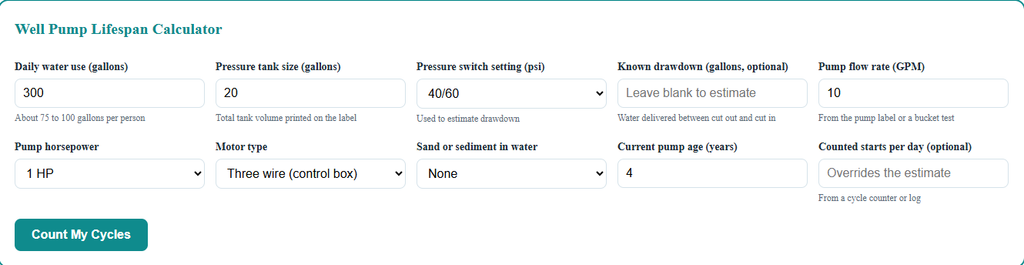
This estimator uses published field data and manufacturer limits to give a planning figure, not a guarantee. Voltage problems, lightning, a well running dry, or a failed check valve can end a pump early regardless of cycle count.
How the Pump Cycle Counter Works
The math is simple once you know one number: drawdown. Drawdown is the water your pressure tank delivers between the pump shutting off and turning back on. Every time you use that much water, the pump starts once.
Step 1: Estimate drawdown
A bladder tank only delivers part of its labeled volume. On a 40/60 switch, drawdown is roughly 26 percent of the tank size, about 30 percent on 30/50, and about 23 percent on 50/70. So a 20 gallon tank on 40/60 gives you only about 5 gallons per cycle.
Step 2: Divide daily use by drawdown
Daily starts are roughly your daily water use divided by drawdown. A family using 300 gallons a day on that 20 gallon tank lands near 58 starts per day. Long showers and irrigation can change the real figure, which is why a counted number always beats an estimate.
Step 3: Check run time
Run time per start is drawdown divided by pump flow. A 10 GPM pump refilling 5 gallons runs for about 30 seconds, which falls well short of the safe minimum. Industry guidance from A.Y. McDonald recommends matching drawdown to at least one minute of pump output for this reason.
Worked Example: Same Pump, Two Different Futures

Nothing changed except the tank. The pump, the well, and the family stayed exactly the same, yet the expected life nearly doubled. A larger tank costs a fraction of a pump pull, which is why it is usually the first upgrade I recommend.

How to Count Your Actual Pump Cycles
Estimates are useful, but counting is better. Here are three ways to get a real number.
- The pressure gauge method. Pick a normal morning and tally every time the gauge needle climbs from cut in to cut out. Multiply a few sample hours to approximate a full day.
- A plug in cycle counter or energy monitor. These log each start on the pump circuit, giving you an exact daily count without guesswork.
- A smart pump protector. Several well pump protection devices record starts, run time, and dry run events, then shut the pump down before damage happens.
While you are at it, watch for rapid on and off clicking at the switch. That pattern is the classic sign of a waterlogged tank or wrong air charge, and it can push starts into the hundreds overnight.
Seven Ways to Cut Pump Cycles and Add Years
- Upsize the pressure tank. This is the single biggest lever. See our guide to the best well pressure tanks and our Well X Trol vs Flexcon vs Water Worker comparison.
- Check the air precharge. With the pump off and the tank drained, precharge should sit 2 psi below cut in. A low charge quietly shrinks drawdown.
- Widen the switch spread. Moving from a 20 psi spread to a wider one increases drawdown, though you should stay within your pump’s rated pressure.
- Consider constant pressure. Variable speed systems ramp up gently instead of slamming on. Our review of constant pressure well pump systems covers the leading options.
- Use a cycle stop valve for irrigation. It keeps the pump running steadily during long draws instead of cycling against a small tank.
- Control sediment. R.C. Worst has seen sandy wells kill pumps in under two years while clean wells passed 15. A sand separator ahead of the tank protects more than just your faucets.
- Protect the motor electrically. Low voltage and surges add heat on every start. An automatic pump controller or surge protection closes that gap.
Calculator says you are cycling too much? Start with the tank. Compare sizes and drawdown ratings in our well pressure tank buying guide, then rerun this calculator with the new numbers.
When the Estimate Says Replace
If your remaining life shows two years or less, do not wait for a cold morning with no water. Learn the signs your well pump is going bad, and price replacement while you still have choices. American Home Shield reports replacements commonly run to $1,700 or more, and constant pressure systems often land between $2,000 and $5,000.
When you do replace it, fix the cycling cause at the same time. Putting a new pump on the same undersized tank simply restarts the clock. Our roundup of submersible well pumps for deep wells can help you match the new pump to your well depth and flow.
Frequently Asked Questions
How many times a day should a well pump cycle?
For a typical home, 10 to 30 starts per day is healthy. Manufacturers allow up to 300 starts per day on small motors and 100 on motors of 1 HP and up, but those are limits, not targets. Staying well below them is what delivers a long life.
What is the minimum run time for a well pump?
Most guidance calls for at least 1 minute of run time per start on motors up to 3/4 HP and 2 minutes on larger motors. That gives the windings time to shed the heat from the starting surge. If your pump runs for less, your tank is likely too small or waterlogged.
How long does a well pump last?
Most residential well pumps last 8 to 15 years. Pumps with low cycle counts, clean water, and stable voltage can reach 20 years or more. Heavy cycling or sand can cut that to just a few years.
Does a bigger pressure tank really extend pump life?
Yes. A larger tank delivers more water per cycle, so the pump starts less often and runs longer each time. In our worked example, moving from 20 to 86 gallons cut daily starts from 58 to 13.
Is a constant pressure system better for pump lifespan?
Variable speed drives soft start the motor, which removes much of the inrush stress that wears pumps out. They are especially useful for irrigation or large households. They cost more upfront and need clean power, so pair them with surge protection.
Also Read On:
👉Best Submersible Well Pumps for Deep Wells: 1/2 HP vs 1 HP vs 1.5 HP by Depth and GPM
👉Best Constant Pressure Well Pump Systems: Variable Speed vs Conventional