Best Solar Pump Controllers and Charge Controllers for Well Setups .
You have picked your panels. You may already own the pump. Now you are looking at controller listings and wondering whether a $100 box and a $300 box really do the same job.
They do not, and the wrong choice is the fastest way I know to turn a good solar well into a pump that stalls every afternoon. According to the EPA, more than 23 million US households get their drinking water from private wells, and the USGS puts that at over 43 million people, roughly 15 percent of the country. A lot of rural homes, cabins, and ranches depend on getting this small component right. US EPAUSGS
This guide covers the two controller types used on solar wells, six units worth your money, and the sizing math that keeps them alive. I have spent more than a decade specifying pumps and troubleshooting failed water systems at Bonvic Drilling, and the controller shows up in more of those failure reports than most buyers expect.
Our editorial team independently selects all products featured in this review. This article may contain affiliate links, and we may earn a commission from purchases made through those links. For more information, please refer to our affiliate disclosure.
Quick Picks: Best Controllers for Solar Well Setups
| Product | Type | Best For | Standout Feature |
|---|---|---|---|
| Victron SmartSolar MPPT 100/50 | Charge controller | Best overall | 98% efficiency, fanless |
| Grundfos CU 202 | Pump controller | SQFlex pumps | App diagnostics |
| SHURflo 902-200 | Pump controller | Small livestock wells | Water level sensors included |
| SunPumps PCA-30-M1D | Pump controller | Low yield wells | Sensorless low water cutoff |
| Renogy Rover 40A | Charge controller | Mid budget | Bluetooth ready |
| EPEver Tracer 4210AN | Charge controller | Tight budgets | RS-485 data logging |
Pump Controller or Charge Controller? Know What Your Well Needs
A solar well runs in one of two ways. In a panel direct system, the panels feed a pump controller, the pump runs while the sun is up, and a storage tank covers nights and cloudy days. In a battery buffered system, a charge controller fills a battery bank, and the pump draws from the batteries on demand.
A pump controller sits between the panels and the pump. It boosts current when sunlight is weak while holding the panels at their maximum power point, which means the pump starts earlier in the morning and keeps running later into the evening. That extra run time is water in your tank. NAZ Solar ElectricRealgoods
A charge controller does a different job: it manages battery charging and protects the bank. It is not built for a pump motor’s starting surge, so never wire a well pump to a charge controller’s load terminals unless the manual explicitly rates it for that current. Mixing up these two roles is the most common wiring mistake I see.
For most private wells with enough tank storage, panel direct is simpler and cheaper. One solar sizing guide estimates that running an existing AC pump on solar requires a battery bank and inverter that add $3,000 to $8,000. Our guide to solar submersible water pumps walks through that decision in more detail. TheGreenWatt
Why MPPT Tracking Matters on a Well
Solar panels produce peak output at one specific voltage, and that point shifts all day with light and temperature. Maximum power point tracking (MPPT) follows it continuously. Older PWM controllers drag panel voltage down to battery voltage and waste the difference as heat.
The gap is real. Victron’s technical datasheet states that under changing cloud cover, a fast MPPT controller can harvest up to 30% more energy than PWM and up to 10% more than slower MPPT units. Renogy goes further, warning that a poorly chosen charge controller can throw away as much as half of your solar output. Victron EnergyRenogy
Climate changes the math. Morningstar notes that MPPT gains are largest in cold climates, while high heat lowers panel voltage and can cancel out the advantage. If your well sits in Arizona or south Texas, a pump controller matched to your pump matters more than chasing the last percent of tracking efficiency. Morningstar
A Field Lesson: The Pump That Quit at 3 PM
A livestock owner once called about a small DC submersible that ran strong at noon and died every afternoon. He had wired two panels straight to the pump to save the cost of a controller. The trough was half empty by evening, and he was convinced the pump was failing.
The pump was fine. Without a current booster, the motor could not start once light dropped, so it sat stalled and heating up every time a cloud passed. We added a linear current booster controller with a float switch at the tank, and the pump started about an hour earlier and ran past sunset.
That is the case for a pump controller in one story. SHURflo claims its controller can raise daily water production by up to 30%, and in my experience that number is believable on marginal light days. The controller also added over voltage protection the direct wired setup never had. Amazon
Best DC Pump Controllers for Solar Wells
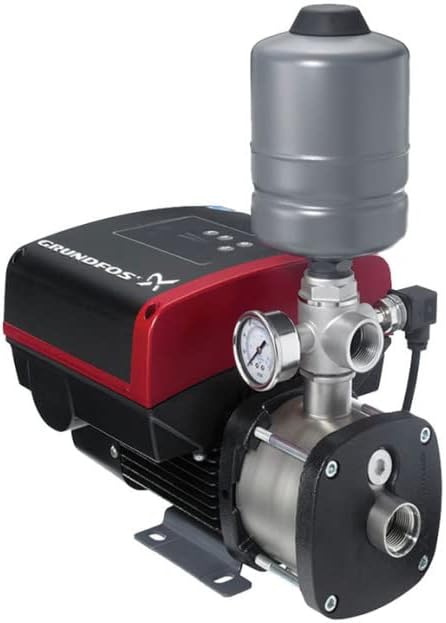
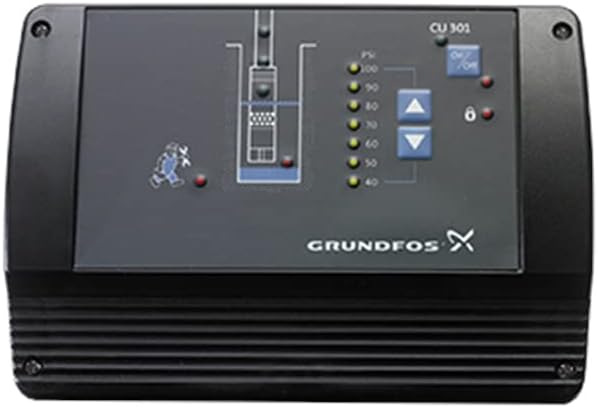
1. Grundfos CU 202: Best for SQFlex Systems
If you run a Grundfos SQFlex, this is the controller to buy. It replaces the older CU 200, which Grundfos has discontinued. The CU 202 pairs with the Grundfos GO app over built in Bluetooth and ships preset for tank filling, so most installs are plug and pump. NAZ Solar Electricshopify
It talks to the pump through the power cable itself, so no extra wiring runs down the well, and it supports remote monitoring over Wi-Fi or Modbus. What I value most is the fault log. When a pump stops, you can see whether it was dry running or low power instead of pulling 300 feet of drop pipe to guess. shopify
Best for: SQFlex owners on deep wells who want remote monitoring.
2. SHURflo 902-200: Best for Small Livestock and Cabin Wells
The 902-200 is built for the SHURflo 9300 series, one of the most common small DC submersibles on American ranches. It switches between 12 and 24 volt operation, includes high and low water sensors to prevent dry running, and comes in a weatherproof enclosure. Add the optional float switch and it shuts the pump off automatically when your tank is full. SolacitySolacity
Know its ceiling. Maximum power output is 150 watts, which makes it ideal for troughs and cabin cisterns, not whole house pressure systems. Steve Regan Company
Best for: 9300 series pumps on shallow to moderate lift wells.
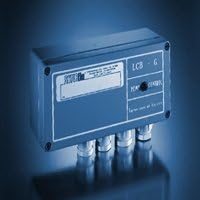
3. SunPumps PCA-30-M1D: Best for Low Yield Wells
This controller is designed for SunPumps SDS pumps but also works with SHURflo 9300 and similar pumps. It includes pump speed control, a remote switch circuit, low water cutoff without sensors, an electronic circuit breaker, and indicator lights. The sensorless cutoff is the standout, since you skip hanging probes down a narrow casing. The Solar BizThe Solar Store
Speed control lets you throttle flow on a well that cannot keep up with the pump. One firm rule: keep the array at 200 watts or less, or the controller may overheat. RES Supply
Best for: Low yield wells where overpumping is the real risk.
Best Solar Charge Controllers for Battery Buffered Wells
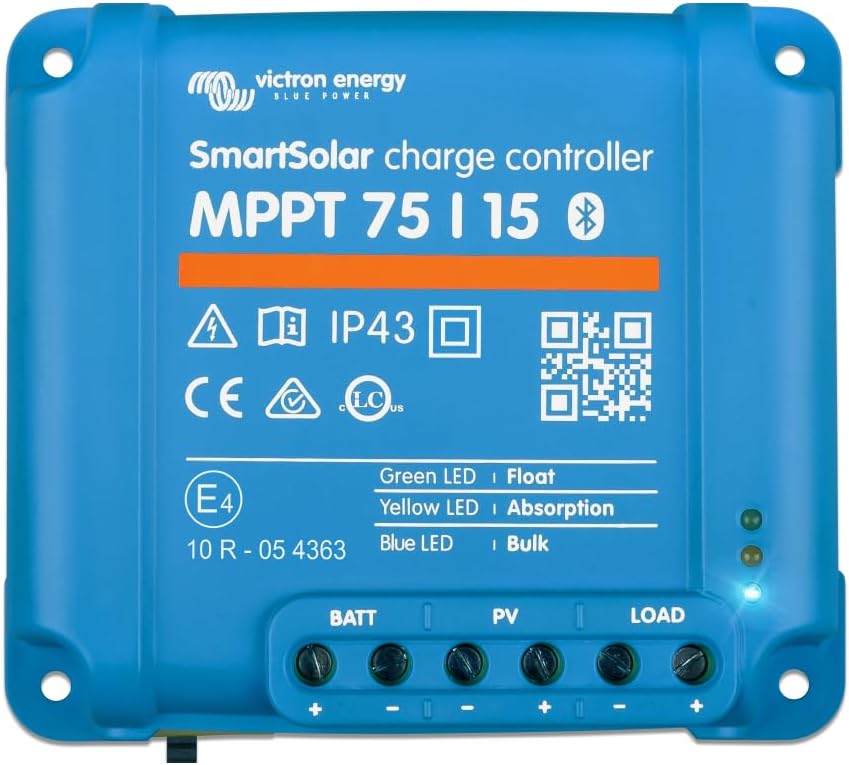
4. Victron SmartSolar MPPT 100/50: Best Overall
Rated for 50 amps of charge current, it handles about 700 watts of solar on a 12 volt bank or 1,400 watts on 24 volts. It runs without a cooling fan and exceeds 98% peak efficiency, and Victron backs its power products with a five year warranty. Victron SmartSolar 100/50 Review (2026): Premium MPPT Tested Off-Grid +2
A fanless design matters in a dusty well house. Street pricing runs around $280 to $320, which is premium, but this is the controller I trust where a dead battery means thirsty animals. OffGrid Benchmark
Best for: 24 volt banks powering a pump inverter or DC booster pump.
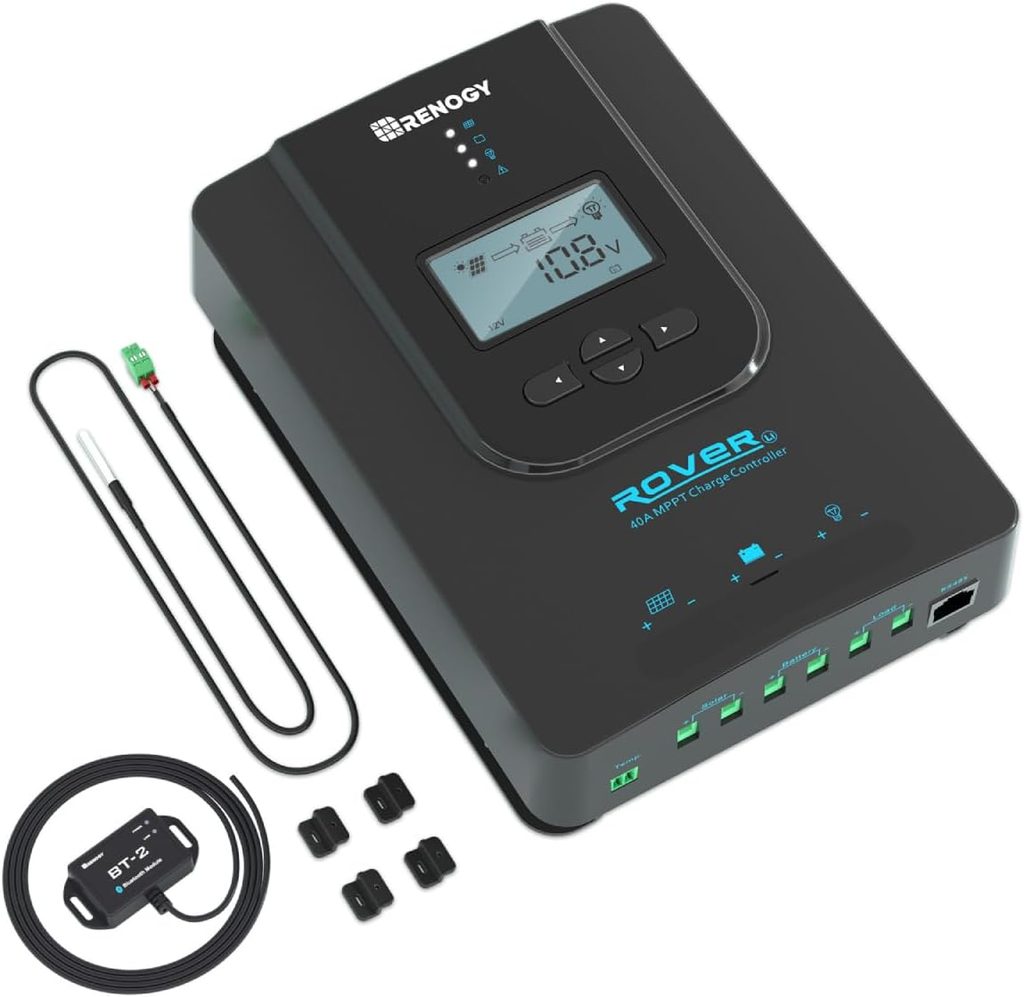
5. Renogy Rover 40A: Best Value With Bluetooth
It accepts panel strings up to 100 volts, with a combined input of 520 watts at 12 volts or 1,040 watts at 24 volts. Renogy recommends a 40 amp ANL fuse between the controller and batteries, so budget for it. RenogyAmazon
It is a sensible middle ground for homeowners who want app monitoring without Victron pricing. Tracking is good, though Victron still leads on long term reliability in hot enclosures.
Best for: Mid size 12 or 24 volt well systems.
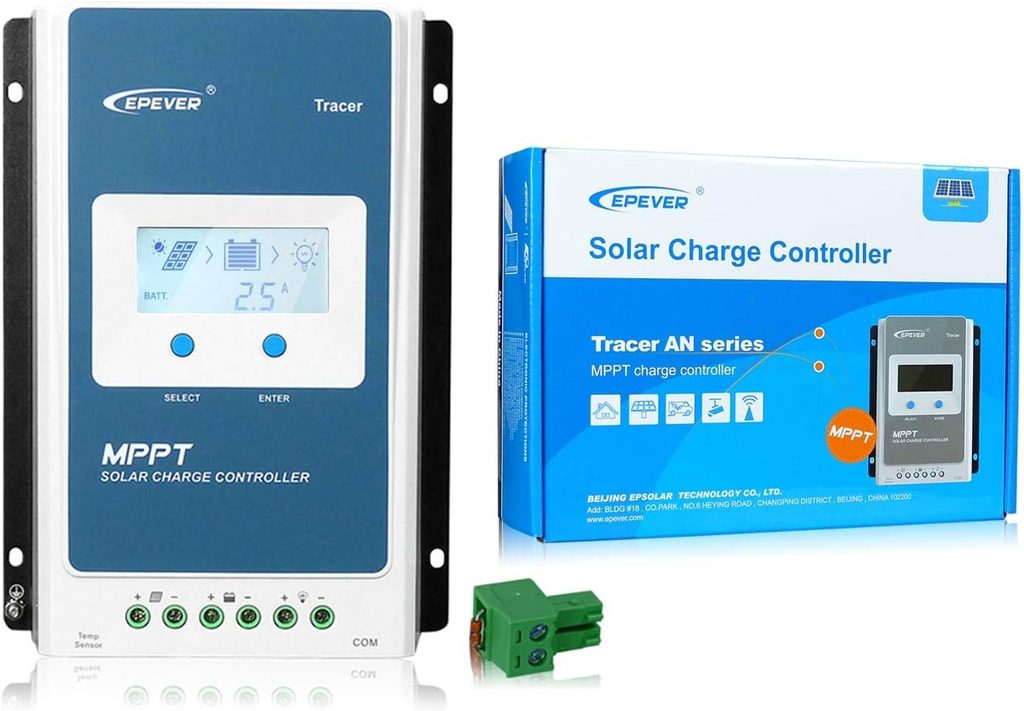
6. EPEver Tracer 4210AN: Best Budget Pick
At roughly $100 for 40 amps of true MPPT charging, it is one of the best values available, with the same 100 volt input as the Renogy. Its RS-485 port supports Modbus, so you can log production and battery data. OffGrid BenchmarkOffGrid Benchmark
Lithium owners need to configure it by hand. LiFePO4 users should pick the user defined profile and set absorption and float voltages manually. OffGrid Benchmark
Best for: DIY builders comfortable adjusting settings.
How to Size a Controller for Your Well: A Worked Example
Say you have an 800 watt array charging a 24 volt battery bank. Divide array watts by battery volts, then add a 25% margin: 800 ÷ 24 × 1.25 = 41.7 amps. A 40 amp unit is too tight, so step up to a 50 amp controller like the Victron 100/50.
Next, check voltage. Panel open circuit voltage climbs on cold mornings, so three 40 volt panels in series (120 volts) would destroy a 100 volt controller. Wire them in parallel or choose a 150 volt model.
Pump controllers are simpler: match your pump brand and stay under the wattage cap. Not sure what pump and array you need? Run your numbers through our solar pump sizing calculator first.
Buying Checklist
Confirm compatibility with your pump model first, because many pump controllers are brand specific. Make sure dry run protection is built in and a float switch input exists. A pump that runs dry for one afternoon can cost more than the controller.
For charge controllers, check maximum PV voltage against your coldest temperatures and choose MPPT for any array above about 200 watts. Favor fanless or sealed designs for dusty well houses, and treat five years as the warranty benchmark.
If your system also feeds household pressure, pair the controller with a properly sized tank. Our well pressure tank guide covers the drawdown math.
Frequently Asked Questions
Can I run a solar well pump without a controller?
Technically yes, but the pump will start late, stall in weak light, and lack dry run protection. A controller usually pays for itself in pump life.
Is MPPT or PWM better for a solar well?
MPPT for nearly every well setup. PWM only makes sense on very small, voltage matched systems in hot climates.
Do I need batteries for a solar well pump?
Usually not. A storage tank holding one to two days of water is cheaper and outlasts a battery bank.
Can a charge controller power my pump directly?
Only if the pump’s starting and running current fall within the load terminal rating. Most submersibles exceed it, so use a dedicated pump controller.
Final Word
For panel direct wells, buy the controller built for your pump: the CU 202 for SQFlex, the 902-200 or PCA-30-M1D for small DC pumps. For battery buffered systems, the Victron SmartSolar 100/50 is my first choice, with the Renogy Rover and EPEver Tracer as solid savings. Size for your coldest morning and your well’s real yield, and the controller will do its job quietly for years.
Also read >>> https://boreholeflow.com/best-shallow-well-jet-pumps/