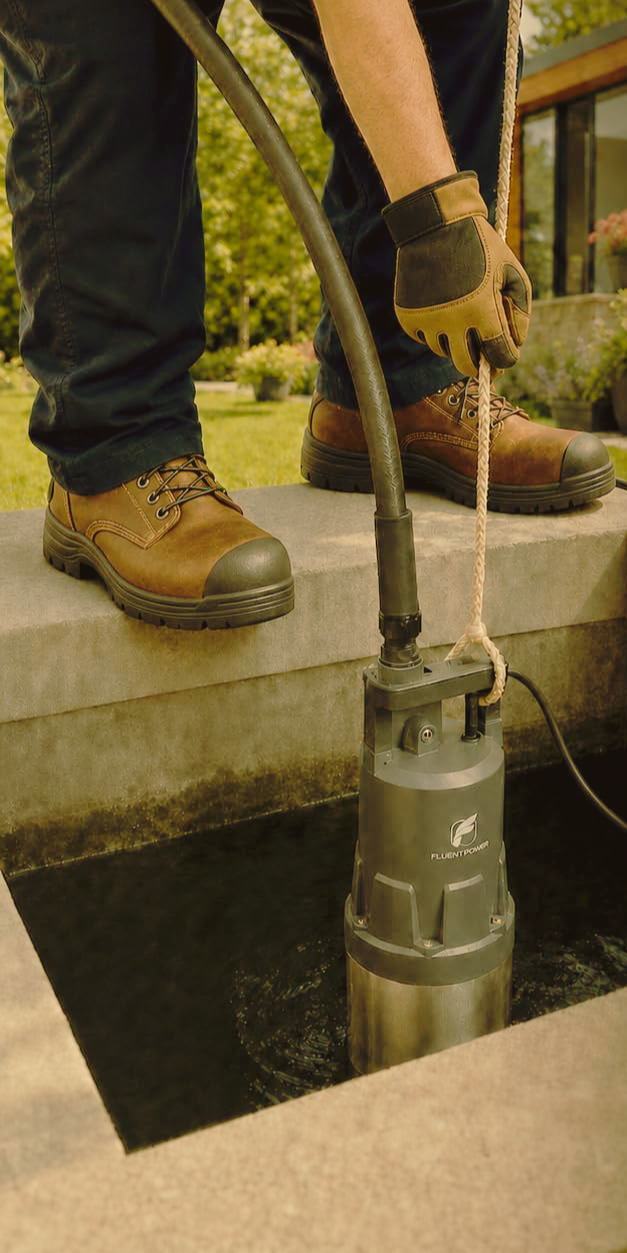
Best Convertible Jet Pumps for 25 to 90 Foot Wells
The short answer
The best convertible jet pumps for 25 to 90 foot wells are the Red Lion RJC-100, the Goulds J10, the WAYNE CWS100, and the Flotec FP4212. The Red Lion is my top pick for most homes because the deep well injector kit comes in the box. The other three earn their place for build quality, warranty, and small household use.
This depth range matters to a lot of people. The EPA estimates that more than 23 million households rely on private wells for drinking water. A large share of those wells hold water in the awkward zone that is too deep for a shallow pump but shallow enough to avoid the cost of a submersible.
I have specified and installed pumps for over a decade as a driller. This guide gives you the numbers I check before I recommend a jet pump, in plain language. Some links below are affiliate links, and our disclosure explains how that works.
Quick picks
| Pump | Best for | Horsepower | Max depth to water | Jet kit included |
|---|---|---|---|---|
| Red Lion RJC-100 | Most homes | 1 HP | 90 ft | Yes |
| Goulds J10 | Long service life | 1 HP | 90 ft | No |
| WAYNE CWS100 | Warranty and value | 1 HP | 90 ft | No |
| Flotec FP4212 | Cabins and small homes | 1/2 HP | 70 ft | No |
How a convertible jet pump works
A convertible jet pump sits above ground and can be set up two ways. For water within 25 feet of the surface, the jet bolts onto the pump nose. For water between 25 and 90 feet down, the jet goes down the well instead.
Why 25 feet is the dividing line
A pump at the surface does not really pull water up. Air pressure pushes it up, and at sea level that pressure is 14.7 psi, enough to support a water column of about 34 feet. Friction and vapor loss cut the practical limit to roughly 25 feet.
Elevation shrinks that limit further. Plan on losing about 1 foot of suction lift for every 1,000 feet above sea level. A home at 5,000 feet may only manage 20 feet of lift.
How the deep well setup beats the limit
In the deep well setup, the pump sends part of its output back down a second pipe. That water shoots through a nozzle and venturi at the bottom, which boosts the pressure and pushes well water up the suction pipe. The pump recycles a share of its own flow to do this, which is why delivery drops as depth increases.
Twin pipe or packer
Wells with 4 inch casing or larger use a twin pipe jet, with two pipes side by side. Narrow 2 inch and 3 inch wells use a packer jet, where the casing itself acts as the second pipe. Measure your casing before you order a jet kit, because the two types do not swap.
What to look for before you buy
Four things decide whether a convertible jet pump will suit your well. Check them in this order.
1. Flow at your depth, not the headline number
The big GPM number on the box is measured at 5 feet of lift and low pressure. The Red Lion RJC-100 shows why that matters. It delivers 20 GPM at 20 psi but only 11.1 GPM at 50 psi, and that is still at 5 feet.
Push the same pump to 60 or 90 feet and delivery falls again. Every manufacturer prints a performance table in the manual. Find the row for your depth to water and read across to 40 psi.
2. Horsepower
A 1/2 HP unit suits one bathroom and light use. A 1 HP unit is the safer choice for a family home with water deeper than 50 feet. More horsepower does not fix a weak well, so match the pump to what the well can yield.
3. Voltage and running cost
All four pumps here run on 115 or 230 volts. The Red Lion draws 16.4 amps on 115 volts and 8.2 amps on 230 volts. Wiring for 230 volts halves the current, which means smaller voltage drop on long cable runs.
Jet pumps are also less efficient than submersibles. Engineering references put jet pump efficiency at 25 to 45 percent, against 40 to 55 percent for a submersible. You trade some power cost for easy access above ground.
4. Housing and what is in the box
Cast iron housings handle years of pressure cycling and are standard on every pick below. The bigger difference is the jet kit. Only one of these four pumps includes it, so add that cost before you compare prices.
The best convertible jet pumps reviewed
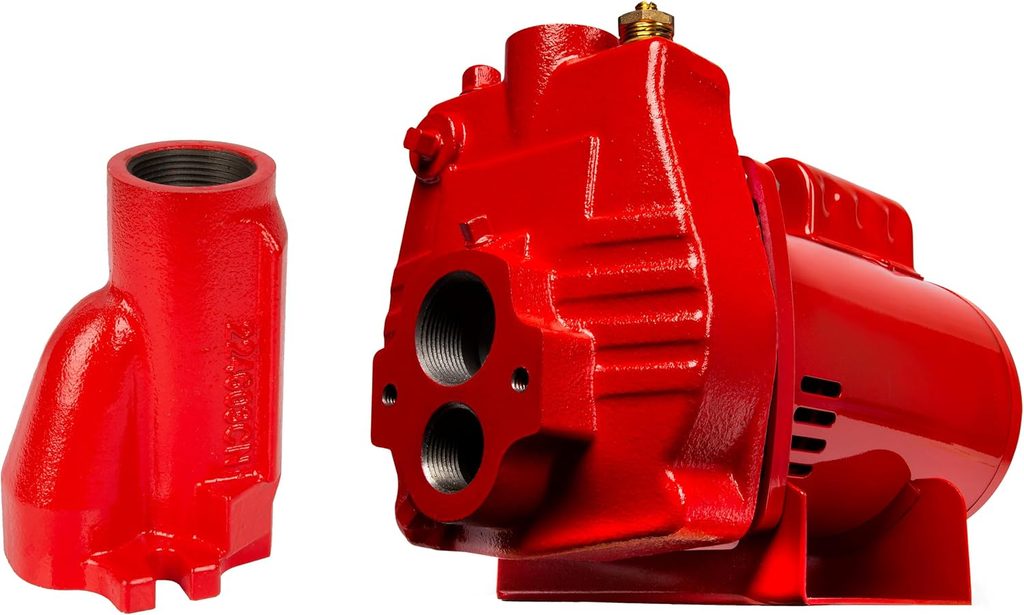
1. Red Lion RJC-100: best overall
The Red Lion RJC-100 is the pump I would put on most 25 to 90 foot wells. It is a 1 HP cast iron unit rated for 20 GPM at shallow lift and a maximum pressure of 71 psi. The injector kit and a preset 30/50 pressure switch both come in the box.
That included kit is the real advantage. You can run it as a shallow well pump today and convert it later if your water level drops. The impeller and diffuser are glass filled thermoplastic, which resists wear from fine grit.
- Good: jet kit included, dual voltage, 1 1/4 inch suction with 1 inch discharge
- Watch for: 16.4 amp draw on 115 volts needs a dedicated 20 amp circuit
Check the Red Lion RJC-100 price on Amazon
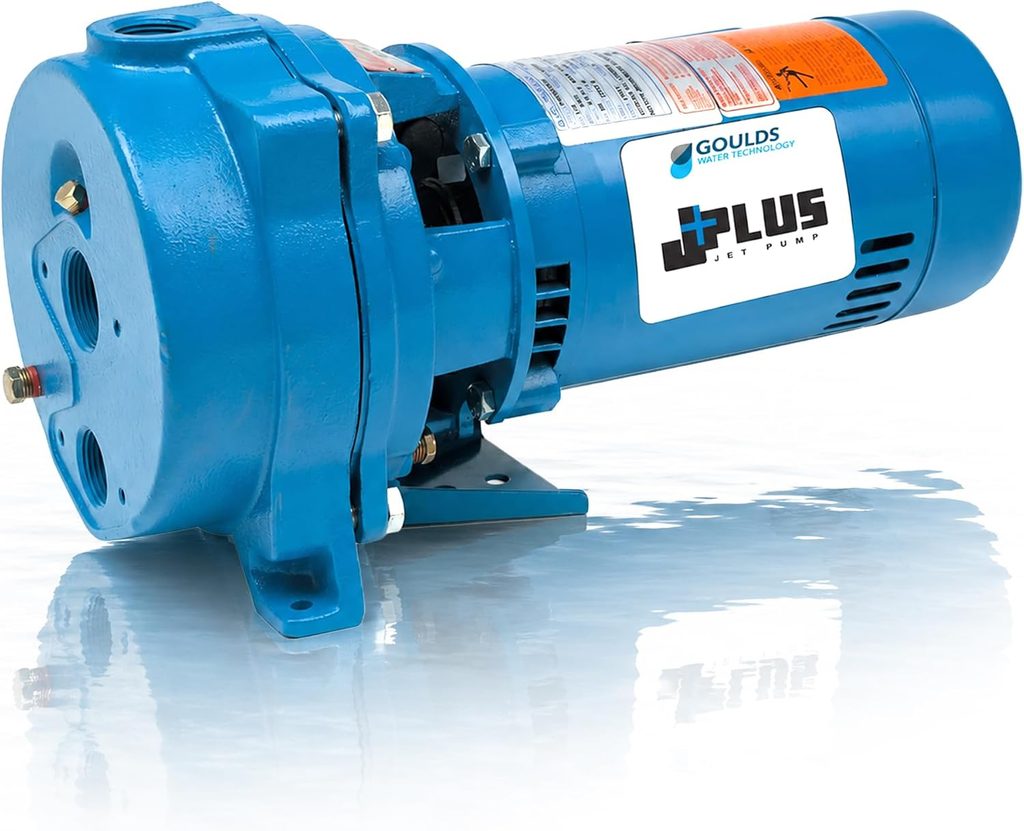
2. Goulds J10: best for long service life
The Goulds J10 is the pump well contractors reach for. It is a 1 HP unit rated up to 24.8 GPM, the highest shallow lift figure in this group. The motor is rated for continuous operation, so long irrigation runs will not hurt it.
Build details set it apart. It has a stainless steel wear ring, a protected mechanical seal, and a back pull out design that lets you service the pump without cutting pipe. The current Amazon listing shows a 3 year warranty.
- Good: continuous duty motor, easy servicing, strong parts supply
- Watch for: the deep well jet package and pressure control valve are sold separately
Check the Goulds J10 price on Amazon
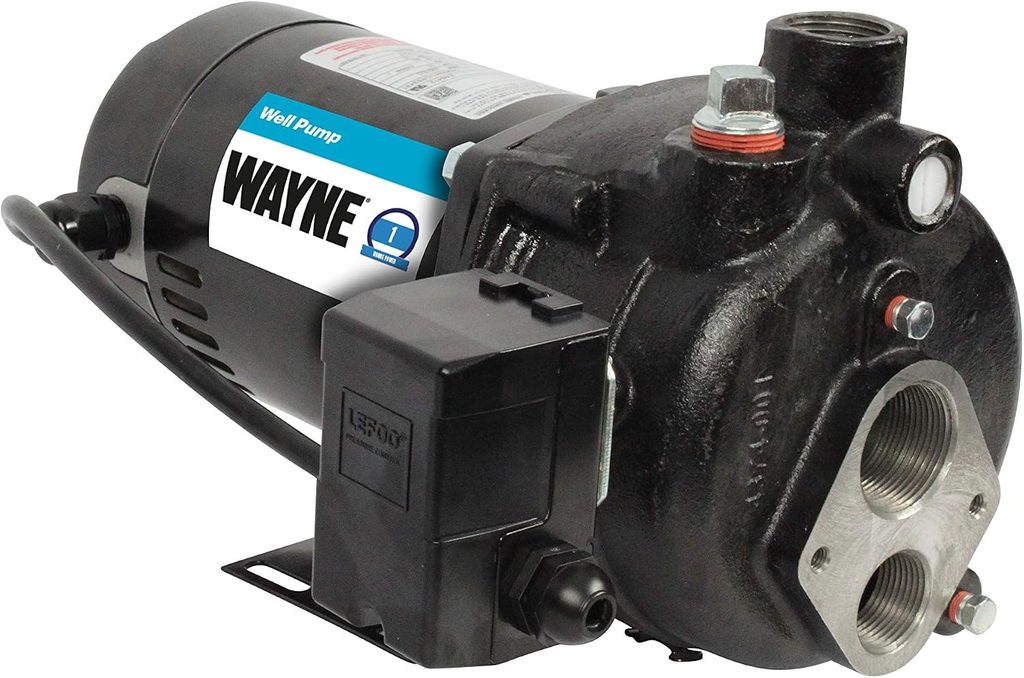
3. WAYNE CWS100: best warranty for the money
The WAYNE CWS100 is a 1 HP cast iron pump for wells up to 90 feet. WAYNE rates it at 588 gallons per hour at 50 psi, which works out to 9.8 GPM. At 10 feet of depth that falls to 444 gallons per hour, or 7.4 GPM.
It draws 13 amps on 120 volts, the lowest of the 1 HP pumps here. It also has a dedicated priming port, which saves real time on first startup. WAYNE backs it with a 3 year limited warranty.
- Good: lower amp draw, simple priming, 3 year warranty
- Watch for: the jet assembly is sold separately and it ships wired for 120 volts
Check the WAYNE CWS100 price on Amazon
4. Flotec FP4212: best for cabins and small homes
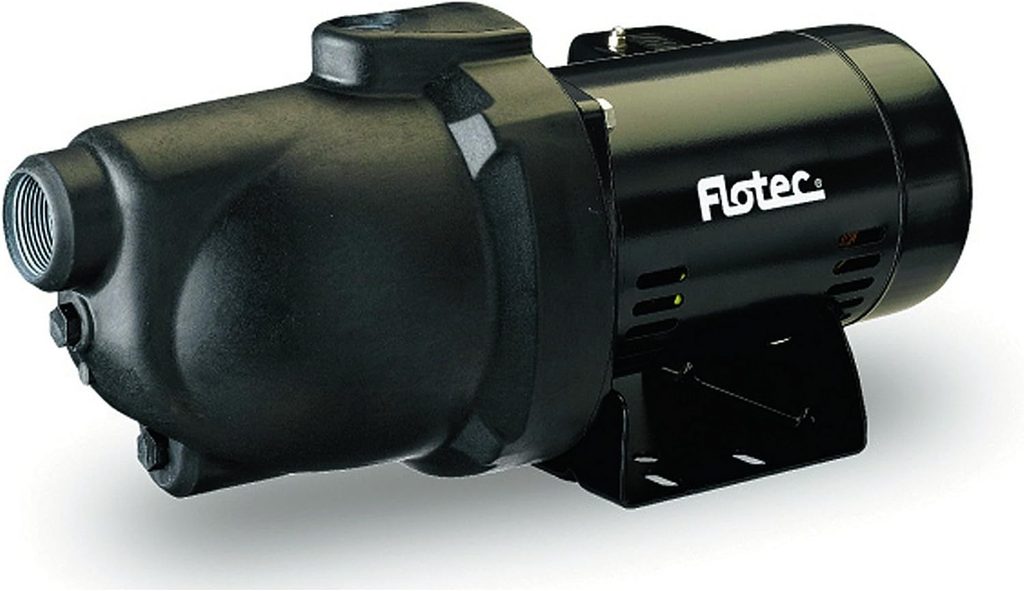
The Flotec FP4212 is a 1/2 HP cast iron pump from Pentair. Its deep well limit is 70 feet to water, not 90. Maximum capacity is 7.9 GPM in the shallow setup, and it delivers 7.1 GPM at 10 feet of lift and 40 psi.
It draws 9.9 amps on 115 volts and runs happily on a 15 amp breaker. That makes it a sensible fit for a weekend cabin or a one bathroom home. The warranty is 1 year, and the jet kit is extra.
- Good: low power draw, compact, simple to wire
- Watch for: 70 foot limit and modest flow rule it out for busy households
How to size your pump: a worked example
Sizing takes three numbers: your depth to water, your peak demand, and your pressure setting. Here is how that plays out for a typical home.
Picture a three bedroom, two bathroom house with four people. The well log shows water at 60 feet while pumping. The pressure switch is set to 30/50.
- Peak demand. Count one GPM for each fixture likely to run at once. A shower, a kitchen tap, and a washing machine come to about 7 GPM.
- Daily use. EPA WaterSense puts the average American family at roughly 300 gallons a day. At 7 GPM, the pump runs about 43 minutes in total each day.
- Pressure. Every 1 psi equals 2.31 feet of head. A 50 psi cut out adds 115 feet of work on top of the 60 foot lift.
- Read the table. Open the manual, find the 60 foot row, and read the flow at 40 psi. If it shows 7 GPM or more, the pump fits.
For this house, a 1 HP pump such as the Red Lion or WAYNE is the right class. A 1/2 HP pump would run short during back to back showers.
Pair the pump with a tank that gives at least one gallon of drawdown per GPM. Our guide to the best well pressure tanks walks through that math. If you plan to run the system off grid, the solar pump sizing calculator estimates panel wattage from the same inputs.
From the field: when the water table moved
A homeowner called me after two dry summers. His shallow well jet pump had worked for nine years, then started sucking air every August. He assumed the pump was worn out.
We dropped a tape down the well. The water level had fallen from 19 feet to 31 feet, which put it past what any surface pump can lift. The pump was fine and the physics had changed.
Because he owned a convertible model, the fix was a twin pipe jet kit set at 45 feet. The job took one afternoon and cost a fraction of a new submersible system. That flexibility is the whole reason to buy convertible.
Installation tips that prevent callbacks
Most jet pump failures I see come from the install, not the pump. These five habits prevent nearly all of them.
- Set the jet below the pumping level. Place it at least 10 feet under the lowest water level you expect in a dry season.
- Fit a foot valve. It holds the prime between cycles, and without it the pump will lose water overnight.
- Prime fully. Fill the pump housing and both pipes before the first start, because running dry ruins the seal in minutes.
- Set the pressure control valve. In deep well mode, adjust it so the pump holds drive pressure while delivering water.
- Protect it from frost. A surface pump must sit in a heated space or an insulated pit below the frost line.
When to skip the jet pump
A convertible jet pump is not the answer for every well. Go with a submersible if your water sits deeper than 90 feet, or if you need more than 10 GPM from below 60 feet. Submersibles push water instead of lifting it, so they hold their flow at depth.
A jet pump still wins when you want every part above ground. You can service it with hand tools and no pulling rig. For a seasonal cabin, that simplicity is worth the lower efficiency.
If your problem is weak pressure inside the house and not the well itself, a jet pump will not fix it. See our guide to the best water pressure booster pump instead. For a wider look at pump types, read our electric water pump guide.
Frequently asked questions
What is the best convertible jet pump for a 90 foot well?
A 1 HP model is the minimum at 90 feet. The Red Lion RJC-100, Goulds J10, and WAYNE CWS100 are all rated to that depth. Expect modest flow at the limit, so check the performance table before you buy.
How deep can a convertible jet pump go?
Most residential convertible jet pumps are rated to 90 feet of depth to water. Some 1/2 HP models stop at 70 feet. The rating refers to the pumping water level, not the total depth of the well.
Can I use a convertible jet pump on a shallow well?
Yes. Bolt the jet to the pump nose and it works as a shallow well pump for water within 25 feet. You can move the jet down the well later if the water level drops.
Do I need a pressure tank with a jet pump?
Yes. The tank stores pressurized water so the pump does not start every time you open a tap. Short cycling is the fastest way to burn out a motor.
Is a 1/2 HP or 1 HP jet pump better?
Choose 1/2 HP for a cabin or one bathroom home with water above 50 feet. Choose 1 HP for a family home or any well deeper than 50 feet. The larger motor costs more to run but keeps pressure steady under load.
The verdict
For most 25 to 90 foot wells, buy the Red Lion RJC-100. It is the only pick with the jet kit in the box, and its 1 HP motor covers a typical family home. Choose the Goulds J10 if you want a pump built to be serviced for decades.
Pick the WAYNE CWS100 if warranty and lower amp draw matter most. Pick the Flotec FP4212 for a small cabin with water above 70 feet. Whichever you choose, measure your pumping water level first, because that one number decides everything else.
Related Reading:>>>https://boreholeflow.com/well-pump-protection-devices/
>>>https://boreholeflow.com/best-solar-pump-controller-for-well/